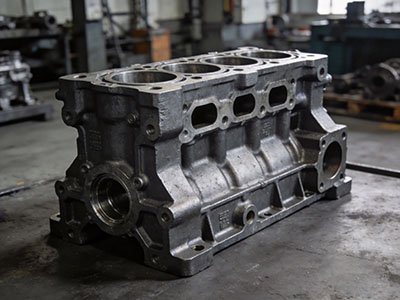
Gray cast iron is the most widely produced casting metal in the world, and for good reason. Its combination of vibration damping, compressive strength, machinability, and low cost makes it the default choice for a huge range of structural and machinery parts. This guide walks through the main industries and parts where gray iron dominates, explains which property drives each application, and maps gray iron grades to typical uses. For the underlying metallurgy and grade definitions, see our reference on gray iron grades.
Why Gray Iron Is So Widely Used
Gray iron's applications all stem from its graphite microstructure. The flake graphite that gives gray iron its name interrupts the metal matrix, producing four standout properties. Vibration damping is exceptional — the flakes absorb and dissipate vibration energy, which is why machine bases and engine blocks are cast in gray iron. Compressive strength is high even though tensile strength is modest. Machinability is the best of any ferrous casting, since the graphite flakes break chips and lubricate the cut. And the cost is low, because gray iron pours at lower temperatures and feeds easily with minimal risering. Gray iron is standardized in the United States under ASTM A48, with classes numbered by minimum tensile strength in ksi — Class 30 means 30,000 psi, for example.
Automotive and Engine Applications
The automotive sector is gray iron's largest market. Gray iron is cast into engine blocks and cylinder heads, where its damping quiets engine noise and its rigidity holds tight bore tolerances. Brake discs and drums rely on gray iron's thermal capacity and friction behavior, and its damping suppresses brake squeal. Flywheels, manifolds, and bearing caps round out the list. While aluminum has displaced gray iron in some lightweight gasoline blocks, gray iron remains dominant in heavy-duty, diesel, and commercial-vehicle engines where rigidity and durability outweigh weight. See how these parts fit broader vehicle programs on our automotive applications page.
Machinery and Machine Tools
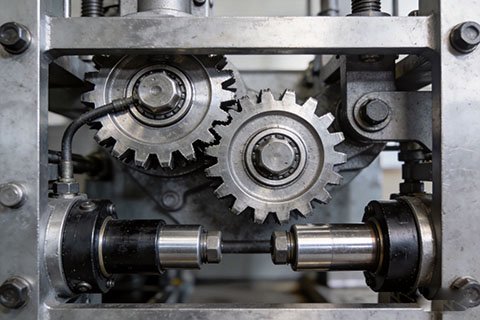
Machine tools depend on gray iron more than any other material. Lathe beds, mill columns, machine bases, and frames are cast in gray iron specifically for its vibration damping — a damped structure produces a better surface finish and longer tool life because chatter is suppressed. The same logic applies to gearbox and transmission housings, compressor bodies, and hydraulic components, where rigidity and dimensional stability matter. Gray iron's machinability is a second advantage here: these are often large, heavily machined parts, and easy cutting directly reduces production cost. Explore related parts on our machinery applications page.
Pump and Valve Applications
Gray iron is a mainstay of fluid-handling equipment. Pump housings and casings, valve bodies and bonnets, and impeller housings are routinely cast in gray iron for water, HVAC, and general industrial service. Its corrosion resistance in water and many neutral fluids is adequate, its compressive strength handles internal pressure well, and its low cost suits the high volumes these parts ship in. For higher-pressure or impact-prone duty, ductile iron is specified instead — see our comparison of gray iron vs ductile iron and the deep dive on pump and valve iron castings. Browse parts on our pipe and valve components page.
Construction and Infrastructure
In construction and municipal infrastructure, gray iron's economy and compressive strength dominate. Manhole covers, drainage grates, and access frames are classic gray iron parts — high compressive load, low cost, and corrosion tolerance in buried service. Pipe fittings, counterweights, and architectural castings also favor gray iron. These applications value bulk strength and value over toughness, which is exactly the trade-off gray iron offers. For higher-impact buried infrastructure such as pressurized pipe, ductile iron is usually specified instead.
Grade-to-Application Guide
| ASTM A48 Class | Min. tensile strength | Typical applications |
|---|---|---|
| Class 20 | 20,000 psi (138 MPa) | Light covers, counterweights, low-stress housings |
| Class 30 | 30,000 psi (207 MPa) | Engine blocks, gearbox housings, general machinery |
| Class 35 / 40 | 35,000-40,000 psi (241-276 MPa) | Machine tool bases, pump & valve bodies, brake parts |
| Class 50 / 60 | 50,000-60,000 psi (345-414 MPa) | High-load machine frames, heavy-duty hydraulic parts |
Higher classes deliver more strength but reduced damping and machinability, so grade selection balances load against the very properties that make gray iron attractive. For help matching grade to part, see how to choose a cast iron material.
Where Gray Iron Is Not Ideal
Gray iron's flake graphite, the source of its strengths, is also its limitation. Gray iron has low ductility and poor impact resistance — it fails in a brittle manner with little warning, so it is unsuitable for shock-loaded or safety-critical tension parts. It also has low tensile strength relative to ductile iron or steel. When an application needs toughness, elongation, or impact resistance — crankshafts, suspension components, pressurized pipe — ductile iron is the right choice. Understanding this boundary is the key to specifying gray iron correctly; compare the two materials directly in gray iron vs ductile iron.
Need gray iron castings for your application? Explore our gray iron castings or request a quote with your part drawings and grade requirements.
Frequently Asked Questions
What is gray iron used for? Gray iron is used for engine blocks, cylinder heads, brake discs and drums, machine tool bases and frames, gearbox and pump housings, valve bodies, manhole covers, and pipe fittings. It is chosen where vibration damping, compressive strength, machinability, and low cost matter more than impact toughness.
Why is gray cast iron so widely used for machines? Gray cast iron is widely used for machines because its flake graphite gives outstanding vibration damping, which suppresses chatter and improves machined surface finish and tool life. Combined with high compressive strength, excellent machinability, and low cost, it is the ideal material for machine bases, frames, and housings.
What are the disadvantages of gray cast iron? Gray cast iron has low ductility, poor impact resistance, and brittle failure with little warning, plus lower tensile strength than ductile iron or steel. It is unsuitable for shock-loaded or safety-critical tension parts, where ductile iron or steel should be specified instead.
What is the strength of gray iron? Gray iron strength is defined by its ASTM A48 class, numbered by minimum tensile strength in ksi: Class 20 is 20,000 psi, Class 30 is 30,000 psi, up to Class 60 at 60,000 psi. Compressive strength is much higher than tensile strength, which is why gray iron excels in compression-loaded parts.
Is gray iron better than ductile iron for applications? Neither is universally better; it depends on the load. Gray iron wins for damping, machinability, and cost in rigid, compression-loaded parts like machine bases and engine blocks. Ductile iron wins where impact resistance, ductility, or tensile strength is required, such as crankshafts, suspension parts, and pressurized pipe.