Iron castings remain the material of choice for pump bodies and valve components because they combine excellent castability, dependable pressure containment, good corrosion resistance in common service media, machinability, and strong cost performance. For low to medium pressure pump body casting, gray iron castings offer excellent vibration damping and ease of machining, while ductile iron castings are preferred when higher pressure, impact resistance, or thinner-wall designs are required. That balance makes iron the default specification for many water, HVAC, fire protection, sewage, and industrial fluid handling systems.
The Role of Iron Castings in Fluid Handling
In fluid handling equipment, the housing does more than contain pressure. It must support rotating parts, maintain seal alignment, absorb vibration, and withstand repeated thermal and mechanical cycling. Iron castings are well suited to this duty because they are stable in service, easy to cast into complex shapes, and economical at production volumes.
Pump and valve manufacturers also value iron because it supports the internal geometries these products need. Volutes, ports, cavities, flange faces, seat bores, and internal passages can all be cast close to final shape, reducing machining time and scrap. That is a major reason cast iron accounts for over 60 percent of pump housings and over 50 percent of valve bodies in industrial applications.
From a procurement perspective, iron also offers a practical advantage over stainless steel and bronze. In many water, neutral chemical, and non-abrasive services, those more expensive alloys do not deliver enough added performance to justify the cost. Iron therefore remains the most efficient answer for many OEMs seeking reliable fluid handling components with predictable manufacturing quality.
Another reason iron dominates is vibration damping. Compared with many steel alternatives, gray iron absorbs operational vibration more effectively, which helps reduce noise, wear, and fatigue in rotating equipment. For pumps in HVAC and municipal water service, that can translate into smoother operation and longer service life.
Pump Body Castings: Gray Iron vs Ductile Iron
Pump body casting selection usually starts with pressure, fluid type, and operating temperature. Gray iron remains the most common choice for standard pump housings because it is economical, easy to machine, and naturally dampens vibration. Ductile iron becomes the better choice when the duty cycle is more demanding or the pressure rating must be higher.
Gray Iron Pump Bodies
Gray iron pump bodies are typically produced to ASTM A48 Class 30 to 35 equivalents, depending on the required strength and service conditions. They are widely used in water pumps, HVAC circulation pumps, and sewage pumps up to about 10 bar. For these applications, the material provides enough strength while keeping manufacturing cost and machining time low.
One of gray iron's biggest advantages is machinability. Internal volutes, passageways, gasket faces, and flange surfaces can be machined accurately and efficiently, which helps maintain hydraulic performance and sealing reliability. Gray iron also has excellent damping characteristics, making it ideal for quieter operation in building services and general water transfer.
Ductile Iron Pump Bodies
Ductile iron pump body castings, commonly specified to ASTM A536 grades such as 65-45-12 or international equivalents like GGG50, provide much higher tensile strength and toughness. That allows pump housings to handle roughly 25 to 40 bar depending on design, wall thickness, and application. Ductile iron is also more resistant to impact loading and mechanical shock.
This makes ductile iron well suited to oil and gas, mining, chemical processing, and fire protection systems. It is often chosen for slurry or abrasive fluids where extra structural margin is needed, and where a wear-resistant coating may be added to extend service life. In some designs, the higher strength of a ductile iron pump body also allows thinner walls or more compact castings without sacrificing pressure capability.
Gray Iron vs Ductile Iron: Practical Comparison
| Factor | Gray Iron | Ductile Iron |
|---|---|---|
| Typical standards | ASTM A48 | ASTM A536 |
| Strength | Moderate | High |
| Machinability | Excellent | Good |
| Vibration damping | Very good | Good |
| Pressure capability | Up to 10 bar in common pump service | About 25-40 bar depending on design |
| Impact resistance | Lower | Higher |
| Cost | Lower | Higher |
| Typical use | HVAC, water, sewage | Fire protection, slurry, oil and gas, higher-pressure pumps |
For most pump housing casting projects, gray iron is the best value when the application is stable, the fluid is not highly aggressive, and the pressure class is moderate. Ductile iron should be specified when the pump must tolerate shock, elevated pressure, abrasive media, or tighter structural safety margins. Temperature also matters, especially when the pump handles hot process liquids or steam-adjacent service.
Valve Body Castings: Gate, Ball, and Check Valves
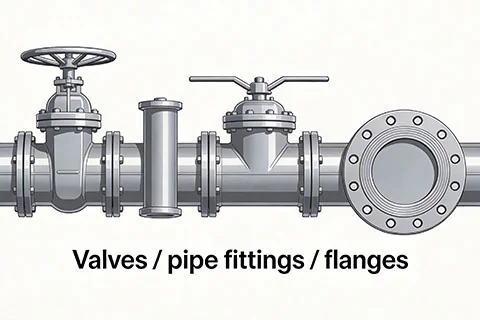
Valve body casting requirements differ from pump housings because the casting must not only contain pressure, but also provide precise seat geometry and stable flange alignment. The body must support sealing surfaces, actuator loads, and repeated opening and closing cycles. That is why material selection is closely tied to valve type and pressure class. Many OEM programs source dedicated pipe and valve components alongside pump housings from a single iron casting partner.
Gate Valve Bodies
Gray iron remains a strong choice for gate valve casting in municipal water distribution, especially in PN10 to PN16 service. In waterworks, a gray iron gate valve body offers the right balance of cost, machinability, and corrosion resistance for neutral water. It is commonly used for larger diameters where material cost becomes a major factor.
For higher pressure or more demanding service, ductile iron is preferred for PN25 to PN40 gate valves and for larger diameters, often DN300 and above. The extra strength helps maintain body integrity under flange loads, installation stresses, and pressure cycling. Ductile iron is also better suited when the valve is part of a critical isolation system.
Ball Valve Bodies
Ball valve bodies generally require stronger pressure containment because they rely on accurate geometry to maintain shutoff integrity. Ductile iron is often the preferred choice for industrial ball valves, especially in oil and gas and process service. It provides the stiffness and impact resistance needed to support seat alignment and pressure-tight sealing.
In an oil and gas ball valve body rated to ANSI Class 300, ductile iron offers a practical route to robust performance without moving all the way to a stainless or forged alloy body. The internal cavity must be machined carefully to maintain ball clearance and seat contact performance. This makes foundry quality and machining accuracy especially important.
Check Valve Bodies
Check valve casting is typically specified in gray iron for standard water service and municipal systems. These valves are often used in pump discharge lines and water distribution networks, where flow reversal prevention is needed without extreme pressure or corrosive loading. Gray iron gives an economical solution for those use cases.
For industrial process lines, ductile iron is often selected instead. The improved toughness helps the valve body tolerate slam conditions, installation loads, and higher operating pressure. It also supports larger check valve formats where body rigidity becomes more important.
Valve Body Selection by Application
| Application | Recommended Material | Why |
|---|---|---|
| Water distribution gate valve in gray iron PN16 | Gray iron | Cost-effective, machinable, suitable for municipal water |
| Oil and gas ball valve body in ductile iron ANSI Class 300 | Ductile iron | Higher strength, better pressure containment |
| Sewage check valve in gray iron for municipal waterworks | Gray iron | Good value for neutral water and wastewater service |
| Industrial process check valve | Ductile iron | Better toughness and pressure margin |
For valve body casting iron, the key is matching the material to the pressure class and service environment. The body is a structural part, but it is also a precision sealing platform. That combination is why ductile iron has gained share in higher-performance valve lines, while gray iron remains dominant in water and general utility service.
Key Engineering Requirements
Choosing iron for pump casing casting or valve body casting is not only about material grade. Engineers must also verify pressure rating, corrosion behavior, temperature limits, sealing requirements, and wall soundness. A casting that meets chemistry but fails dimensional or pressure expectations will still create field problems.
Pressure Rating
Pressure class is one of the first filters in material selection. For valves, common PN pressure rating categories include PN6, PN10, PN16, PN25, and PN40, while ANSI Class systems often include Class 125, 150, 250, and 300. Gray iron is widely used in lower to medium pressure ranges, while ductile iron is better suited for the upper end of those ratings.
For pump housings, gray iron is typically used up to around 10 bar in standard service. Ductile iron pump body designs can extend to about 25 to 40 bar depending on geometry and wall thickness. In both cases, the casting design must include enough wall section to withstand hydrostatic and operational loads with adequate safety margin.
Corrosion Resistance
Cast iron performs well in water, steam, and many neutral or mildly alkaline fluids. That is why it remains common in municipal waterworks, HVAC, and fire protection systems. However, it is not the best choice for strongly acidic, high-chloride, or highly oxidizing environments unless protective coatings or material upgrades are used.
For more aggressive fluids, engineers may specify epoxy coatings, internal linings, or a move to alloy materials. Even then, iron may still be selected for the outside structure if the lining or coating handles the media side. This approach preserves cost advantages while extending corrosion resistance.
Sealing and Seat Compatibility
Cast iron's machinability makes it especially useful where accurate seat surfaces are required. Flange faces, seat bores, and port interfaces can be machined to consistent dimensions, supporting elastomer and metal seat designs. That is important in gate valve casting, ball valve bodies, and pump housings with precision flange and seal interfaces.
Good machining also helps reduce leakage risk and ensures repeatable assembly. In practice, the material choice and the machining process must be treated as one system. A good casting with poor finish or poor flatness will still fail the sealing requirement.
Temperature Limits
Gray iron is commonly used in service up to around 300 to 350 degrees C, depending on design, loading, and environment. Ductile iron can often operate up to about 400 to 450 degrees C under suitable conditions, again depending on grade and duty. Above those limits, strength retention and dimensional stability become more critical.
Temperature affects both the housing and the sealing system. Even if the casting itself remains intact, gasket materials, seat materials, and machining tolerances may shift at elevated temperatures. That is why operating temperature should always be part of the material decision.
Wall Thickness and Soundness
Wall thickness is a major determinant of pressure containment. Thin walls may reduce weight, but they also increase risk of distortion, porosity sensitivity, and fatigue under cyclic loading. Sound casting design must account for local hotspots, sharp transitions, and section changes around flanges and bosses.
For pump casing casting and valve body casting, solidification control is essential. Proper gating, risering, and feeding help prevent shrinkage defects and ensure sound sections where pressure loads are highest. In fluid handling applications, the quality of the casting is often as important as the nominal alloy.
Quality Standards for Pump and Valve Castings
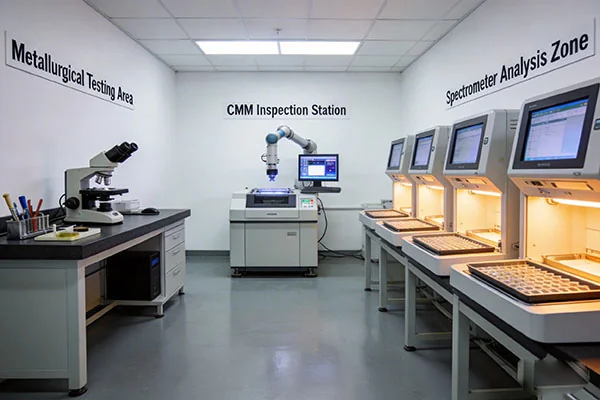
Pump and valve buyers should define both material and acceptance criteria. Standards help ensure repeatability across batches, suppliers, and production sites. They also reduce the risk of field failures and simplify incoming quality control.
Common Standards
ASTM A48 covers gray iron castings and is widely used for pump body casting and gray iron valve body production. ASTM A536 covers ductile iron castings and is the key reference for higher-strength pump and valve components. European equivalents such as EN 1561 and EN 1563 are also commonly used in global sourcing.
For valves, industry and application standards matter as much as material grades. API 6D is commonly used for pipeline valves, API 600 for gate valves, and AWWA C500/C509 for waterworks valves. ISO 5208 is a core reference for pressure testing and leakage performance.
Testing and Inspection
A hydrostatic pressure test is one of the most important validation steps. The usual practice is to test at 1.5 times working pressure, although exact test procedures can vary by standard and customer specification. This confirms body integrity, joint sealing, and pressure containment before shipment.
Dimensional inspection is equally important, especially for valve bodies where mating surfaces and sealing interfaces must be accurate. CT8 to CT10 dimensional tolerance is a typical target range for many valve body castings, depending on size and complexity. Surface defect inspection, visual review, and dye penetrant checks can help detect surface cracks, laps, or other discontinuities.
Material certification should include chemical composition and tensile test results. For procurement teams, traceability is essential because it ties each part to its melt lot, process record, and inspection data. That is especially important for critical service applications and repeat production.
Related reading: Quality control ensures pipe and valve casting reliability — explore our quality assurance process.
Why Choose Matson Iron Casting for Pump and Valve Parts
Matson supports pump and valve OEMs with iron casting capability built around production consistency and application fit. Green sand and resin sand casting services are used for pump housings up to 500 kg, while no-bake molding supports larger valve bodies up to 2 tons. That range covers many industrial and municipal specifications without requiring multiple suppliers.
Machining services are integrated into the process, including CNC machining for flanges, seat bores, threaded ports, and other critical interfaces. This helps reduce fit-up risk and supports tighter dimensional control on finished assemblies.
Quality control includes pressure testing, dimensional CMM inspection, and material traceability. This is especially valuable for buyers who need consistent repeat orders and documented conformance. If you are developing a new pump casing casting or gate valve casting program, Matson can support prototype, pilot, and production volumes with on-time delivery focus. Explore custom cast iron parts for engineered housings tailored to your drawings.
Frequently Asked Questions
Is gray iron or ductile iron better for pump body castings?
Gray iron is usually better for standard low to medium pressure pump body casting because it is cheaper, easier to machine, and offers excellent vibration damping. Ductile iron is better when the pump must handle higher pressure, shock loading, or abrasive fluids.
What pressure ratings can cast iron valve bodies handle?
Cast iron valve bodies are commonly used in PN6 to PN40 and ANSI Class 125 to 300 service, depending on the alloy and design. Gray iron is typically used in lower to medium pressure applications, while ductile iron supports higher ratings and more demanding service.
How does cast iron perform in corrosive fluid environments?
Cast iron performs well in water, steam, and neutral fluids, but it is limited in acidic or high-chloride environments. In more aggressive service, coatings, linings, or upgraded alloys are often required to achieve acceptable corrosion resistance.
What are the common quality standards for pump and valve castings?
The most common material standards include ASTM A48 for gray iron and ASTM A536 for ductile iron. For valve performance and testing, API 6D, API 600, AWWA C500/C509, and ISO 5208 are frequently used.
Can cast iron pump housings be machined for custom port configurations?
Yes. Cast iron is highly machinable, which makes it suitable for custom port layouts, flange patterns, threaded ports, and modified internal passages. This is one reason pump housing casting is so widely used in OEM engineering.
What is the typical lead time for custom pump body castings?
Lead time depends on casting size, tooling complexity, machining scope, and test requirements. For custom projects, a typical schedule includes pattern development, trial casting, machining, and validation before volume production.
Need pump body or valve body castings for your fluid handling equipment? Request a Casting Quote