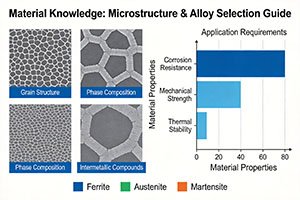
Gray iron and ductile iron differ mainly in graphite shape, which drives large differences in strength, ductility, damping, machinability, and cost, so the “right” choice depends on how the component is loaded and how it must perform in service.
What Is Gray Iron?
Gray iron is the most widely used cast iron, named for the gray appearance of its fracture surface caused by interconnected graphite flakes in a pearlitic or ferritic–pearlitic matrix. Per ASTM A48, gray iron is specified primarily by minimum tensile strength, without a defined yield strength because the flake graphite causes early microcrack initiation and a non‑linear stress–strain curve. Typical compositions are about 2.9–3.7% C, 1.5–3.0% Si, with small amounts of Mn, P, and S, and the relatively high carbon and silicon promote the formation of free graphite flakes rather than combined carbides.
The flake graphite provides very good vibration damping and thermal conductivity, plus excellent machinability because the flakes act as chip‑breakers and internal lubricants at the tool–chip interface. However, the sharp graphite flakes also concentrate stress, leading to low tensile strength, almost no measurable elongation, and brittle behavior under impact or bending. As a result, gray iron is well suited for components loaded mainly in compression, or where stiffness, damping, and manufacturability are more important than tensile or impact strength.
Gray iron castings are commonly produced using sand molds; for a full workflow overview, see our sand casting process guide.
ASTM A48 Grades and Mechanical Properties
Below is a typical mechanical properties map for common gray iron grades often labeled GG15–GG35 in foundry practice and correlated to ASTM A48.
| Grade (foundry) | Approx. ASTM A48 class | Typical tensile strength (MPa) | Typical yield strength (MPa) | Hardness (HB) | Elongation (%) |
|---|---|---|---|---|---|
| GG15 | Class 20 | 150–170 | Not defined (very low) | 150–180 | ~0 |
| GG20 | Class 25 | 180–200 | Not defined | 160–190 | ~0 |
| GG25 | Class 30 | 200–220 | Not defined | 170–200 | ~0 |
| GG30 | Class 35 | 230–260 | Not defined | 180–220 | ~0 |
| GG35 | Class 40 | 260–300+ | Not defined | 190–230 | ~0 |
Because ASTM A48 focuses on tensile strength, hardness is often used as a process control parameter, and ductility is not specified.
EN 1561 and JIS G5501 Equivalents
Under EN 1561, gray iron is designated EN‑GJL‑xxx based on minimum tensile strength in MPa in a standard test bar. Typical mappings are: GG15 ≈ EN‑GJL‑150 GG20 ≈ EN‑GJL‑200 GG25 ≈ EN‑GJL‑250 GG30 ≈ EN‑GJL‑250 / 300 (depending on actual strength range) GG35 ≈ EN‑GJL‑300 Under JIS G5501 (FC grades), common approximate correspondences are: GG15 ≈ FC150 GG20 ≈ FC200 GG25 ≈ FC250 GG30 ≈ FC250 / FC300 GG35 ≈ FC300 These equivalences are approximate and final selection must reference each standard’s test bar size and sampling rules.
Common Industrial Applications
Gray iron grades are chosen where compressive loads, stiffness, and damping dominate: GG15 / EN‑GJL‑150 / FC150: Light machine housings, pump bodies, covers, low‑stress brackets. GG20 / EN‑GJL‑200 / FC200: Small engine housings, gearboxes, appliance components, general machinery frames. GG25 / EN‑GJL‑250 / FC250: Machine tool beds, gear housings, compressor cylinders, pump casings, low‑speed bearing housings. GG30 / EN‑GJL‑250–300 / FC250–300: Medium‑duty brake drums/discs, flywheels, engine blocks, heavy machine bases. GG35 / EN‑GJL‑300 / FC300: Heavy machinery bases, high‑load gear housings, pressure‑tight cylinders with mainly compressive stress. These applications exploit gray iron’s damping, thermal conductivity, and machinability while keeping tensile and impact stresses within safe limits.
What Is Ductile Iron?
Ductile iron (nodular or spheroidal graphite iron) is a cast iron in which graphite precipitates as nearly spherical nodules rather than flakes, achieved by adding a small amount of Mg or Ce to the melt before casting. Per ASTM A536, ductile iron grades are defined by minimum tensile strength, yield strength, and elongation percentage, reflecting its steel‑like, ductile stress–strain behavior. Typical compositions are similar to gray iron in C and Si, but process control (inoculation, Mg treatment, solidification rate) is tighter to ensure a nodule count and morphology that deliver the desired mechanical properties.
The spheroidal graphite nodules interrupt crack propagation much less than flakes, giving much higher tensile strength, clear yield behavior, and usable elongation (from a few percent up to 18–20% for ferritic grades). Ductile iron therefore bridges the gap between gray iron and low‑carbon steel, often matching steel forgings in strength while keeping casting design and cost advantages. It has somewhat lower damping and thermal conductivity than gray iron and is tougher to machine, but still machinable for most industrial volumes with appropriate tooling.
ASTM A536 Grades and Mechanical Properties
ASTM A536 uses a three‑number designation: tensile strength–yield strength–elongation in ksi and percent. Typical engineering values and approximate hardness ranges are:
| ASTM A536 / DIN (GGG) | EN 1563 (EN‑GJS) approx. | Tensile strength (MPa) | Yield strength (MPa) | Elongation (%) | Hardness (HB) |
|---|---|---|---|---|---|
| GGG40 (≈ 60‑40‑18) | EN‑GJS‑400‑18 | 400–450 | 250–280 | 15–18 | 130–170 |
| GGG50 (≈ 65‑45‑12) | EN‑GJS‑450‑12 | 450–500 | 280–320 | 10–14 | 150–190 |
| GGG60 (≈ 80‑55‑06) | EN‑GJS‑500‑7 | 500–600 | 350–380 | 5–10 | 170–220 |
| GGG70 (≈ 100‑70‑03) | EN‑GJS‑700‑2 | 700–750 | 450–500 | 2–3 | 200–260 |
| GGG80 (≈ 120‑90‑02) | EN‑GJS‑800‑2 / 900‑2 | 800–900+ | 600–650+ | 1–2 | 230–300 |
These values are consistent with typical ductile iron grade charts from producers and handbooks.
Common Industrial Applications
By grade, typical usage patterns are: GGG40 / 60‑40‑18 / EN‑GJS‑400‑18: Pump and valve bodies, low‑pressure fittings, automotive suspension arms and control arms where high ductility and fatigue resistance are needed. GGG50 / 65‑45‑12 / EN‑GJS‑450‑12: General‑purpose automotive brackets, housings, gear carriers, steering knuckles, medium‑pressure pipe fittings. GGG60 / 80‑55‑06 / EN‑GJS‑500‑7: Axle housings, differential carriers, crankshafts, heavy gear hubs, where higher strength and moderate ductility are required. GGG70 / 100‑70‑03 / EN‑GJS‑700‑2: Highly loaded gears, wheel hubs, high‑strength flanges, powertrain components replacing medium‑carbon steels. GGG80 / 120‑90‑02 / EN‑GJS‑800‑2 / 900‑2: Very high‑strength crankshafts, pressure components, and special heavy‑duty parts where steel forgings are being replaced for cost and casting‑design advantages. In all these cases, ductile iron is selected when a combination of tensile strength, yield strength, impact resistance, and fatigue performance is critical.
Key Differences at a Glance
| Attribute | Gray iron (EN‑GJL / ASTM A48) | Ductile iron (EN‑GJS / ASTM A536) |
|---|---|---|
| Graphite morphology | Flake graphite | Spheroidal (nodular) graphite |
| Typical tensile strength | ~150–350 MPa (Class 20–40) | ~400–800+ MPa (60‑40‑18 to 120‑90‑02) |
| Yield strength | Not well defined, very low | Clearly defined, ~250–650+ MPa depending on grade |
| Elongation at break | ~0% (brittle) | ~2–18% depending on grade |
| Machinability | Excellent, free‑cutting, low tool wear | Good but lower; higher tool wear due to strength and toughness |
| Vibration damping | Very high (among the best of metals) | Moderate, lower than gray iron |
| Wear resistance | Good for sliding with graphite lubrication | Good; can be superior with pearlitic or heat‑treated grades |
| Impact toughness | Low, prone to brittle fracture | High relative to gray iron; suitable for impact/variable loads |
| Thermal conductivity | Higher | Lower |
| Typical cost (raw casting) | Lower cost per kg | 10–25% higher per kg in 2025–2026, depending on region |
Gray iron’s flake graphite creates many internal stress concentrators, so cracks initiate easily, limiting tensile strength and eliminating meaningful elongation but dramatically improving damping and machinability. Ductile iron’s nodular graphite reduces stress concentration, so it carries significantly higher tensile and yield loads with measurable ductility and impact resistance, at the expense of some damping and ease of machining.
For dynamic machinery, the higher impact toughness and fatigue strength of ductile iron make it safer where shock, bending, or cyclic loads dominate, such as crankshafts, axles, and highly stressed gears. For large static machine frames or housings where stiffness, stability, and vibration control matter more than ultimate strength, gray iron’s damping performance often leads to better accuracy and tool life in service.
From a cost perspective, ductile iron requires Mg treatment, tighter process control, and often more expensive charge materials, which raise melt and scrap control costs; this typically translates into a 10–25% higher price per kg compared with similar gray iron castings in 2025–2026, depending on region and part complexity. However, in many safety‑critical or high‑load uses, the ability to shrink cross sections, reduce weight, and replace steel forgings can more than offset the higher base material price.
When to Choose Gray Iron
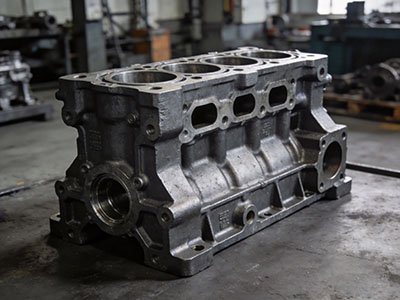
Industrial machinery applications
Engineers choose gray iron where vibration damping, dimensional stability, and stiffness dominate design priorities, especially for large bases and housings in machine tools and industrial equipment. Machine tool beds and columns made from grades like GG25/GG30 (EN‑GJL‑250/300, FC250/FC300) benefit from gray iron’s high damping, which reduces chatter, improves surface finish, and extends tool life in milling, turning, and grinding operations. The graphite network also helps resist thermal shock and distribute local heat, improving stability under fluctuating cutting temperatures and coolant flows.
Brake discs and drums for passenger vehicles and commercial trucks frequently use higher‑strength gray iron grades such as GG25–GG35 or EN‑GJL‑250–300, because they combine good wear resistance with high thermal conductivity to dissipate friction heat quickly. This reduces the risk of hot spotting and thermal cracking compared with lower‑conductivity materials, while the graphite provides a lubricating effect that stabilizes the friction coefficient against pads. Other common examples include compressor and pump housings, gearboxes, and engine blocks where the loading is predominantly compressive, and where casting complexity, damping, and machinability are more important than extreme tensile strength.
Cost‑effective high‑volume production
Gray iron is often the more economical choice for high‑volume production of moderately loaded components because it is easier to cast and machine, with lower tool wear and higher cutting speeds than ductile iron. Foundries can achieve high yields and short cycle times with gray iron, and the absence of Mg treatment makes melting and inoculation simpler and cheaper, especially for large furnaces and automated lines.
For parts such as pump bodies, small housings, covers, bearing caps, and low‑stress brackets, using GG20–GG25 instead of ductile grades can cut casting cost per kilogram and reduce machining cost per part, without compromising performance when design stresses are low. In many OEM programs, this combination of low material cost and fast machining makes gray iron the best total‑cost solution over millions of pieces, provided the load cases remain within its brittle limitations.
For many OEM programs, explore our custom cast iron parts portfolio when specifying gray iron in volume production.
When to Choose Ductile Iron
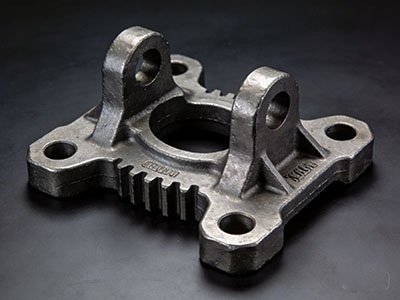
Ductile iron is preferred when components must withstand high tensile loads, impact, or cyclic fatigue, or when designers want to reduce section thickness and weight compared with gray iron. Automotive crankshafts are a classic example: ductile iron grades such as GGG60–GGG70 (80‑55‑06 / 100‑70‑03, EN‑GJS‑500‑7 / 700‑2) achieve strength levels comparable to forged steels while allowing near‑net‑shape casting of counterweights and oil passages. This can eliminate forging dies and extensive machining, delivering substantial cost savings at high volumes while maintaining reliable fatigue performance under engine torsional and bending loads.
Pump fittings, pressure pipe components, and heavy machinery gears often use ductile iron because of its superior combination of yield strength and elongation, which allows them to survive pressure surges, misalignment, and shock loads that would crack gray iron. In earthmoving and construction equipment, ductile iron is widely used for structural components such as axle housings, hubs, and brackets, where toughness and resistance to impact from uneven ground or sudden loads are essential. Many OEMs have replaced medium‑carbon steel forgings with high‑strength ductile iron grades (for example, EN‑GJS‑700‑2 or EN‑GJS‑800‑2), achieving total cost reductions via casting design freedom, reduced machining stock, and lower fabrication and welding requirements—even if the per‑kg material price is somewhat higher.
When ductile iron is the right choice, OEM casting services from Matson help align grade selection with part geometry and loads.
Cost Comparison (2025–2026)
Market data and foundry surcharge schedules from 2025–2026 show that gray iron remains the lower‑cost option per kilogram, with ductile iron typically carrying a noticeable but manageable premium. For example, foundry surcharges in early 2026 show a higher rate for ductile iron than gray iron per pound of raw casting, reflecting higher alloy and treatment costs, while broader commodity pricing in 2025 placed grey cast iron around 2700–3000 USD/ton in key markets with ductile iron somewhat higher. In many regions, this translates into roughly a 10–25% raw casting price premium for ductile iron compared with a functionally similar gray iron part, all else being equal.
Key cost drivers include:
Material and treatment costs: Mg treatment, tighter chemistry control, and higher scrap requirements for ductile iron.
Processing costs: More stringent nodularity control, higher rejection risk, and sometimes slower cooling or additional heat treatment to achieve desired microstructures.
Machining costs: Ductile iron’s higher strength and toughness increase tool wear, reducing cutting speeds versus gray iron and raising per‑part machining cost.
In a simplified break‑even view, gray iron is usually more economical for low‑to‑moderate mechanical demands and very high volumes where tooling and machining dominate total cost. As load and safety requirements increase—forcing thicker gray‑iron sections or steel designs—ductile iron often becomes the lower total‑cost choice by allowing thinner walls, weight reduction, and the replacement of welded or forged assemblies with a single cast component, especially above mid‑to‑high annual volumes.
Contact our engineering team for project-specific pricing and material comparison.
FAQ
Graphite microstructure difference (for engineers)
The main microstructural difference is that gray iron contains interconnected graphite flakes, while ductile iron contains discrete graphite nodules (spheroids) dispersed in the metallic matrix. In gray iron, the sharp flake tips act as stress raisers, causing early microcracking, low tensile strength, and essentially zero elongation but providing high vibration damping and excellent machinability due to easy crack initiation and graphite lubrication. In ductile iron, the rounded nodules greatly reduce local stress concentration, enabling higher tensile and yield strength, usable ductility, and improved impact toughness that approaches low‑carbon steels, while still retaining castability and some damping benefits relative to steels.
Is ductile iron stronger than gray iron?
Yes. Across typical engineering grades, ductile iron is significantly stronger and more ductile than gray iron.
| Property | Gray iron (EN‑GJL‑200–300) | Ductile iron (EN‑GJS‑400‑18 to 800‑2) |
|---|---|---|
| Tensile strength | ~150–300 MPa | ~400–800+ MPa |
| Yield strength | Not defined / very low | ~250–650+ MPa |
| Elongation at break | ~0% | ~2–18% |
These ranges summarize typical catalog values for common structural grades in each family.
Which is more expensive, and by how much (2025–2026)?
Ductile iron is generally more expensive than gray iron, with a typical 2025–2026 cost premium of around 10–25% per kilogram or ton for comparable casting sizes and complexity, depending on region and contract terms. The main cost drivers are the magnesium or cerium treatment for nodularity, stricter process control and quality requirements, higher scrap risk when nodularity targets are not met, and higher machining costs due to greater strength and hardness. In contrast, gray iron uses simpler melting and inoculation practices, has very high machinability, and often achieves higher foundry yields, making it more economical where its lower strength is acceptable.
When should an engineer choose gray iron over ductile iron?
An engineer should choose gray iron when the component is loaded mainly in compression or moderate bending, when vibration damping and dimensional stability are critical, and when cost and machinability are key drivers. Typical examples include machine tool beds and columns, engine blocks, compressor housings, large gearboxes, and automotive brake discs/drums, where grades such as GG25–GG35 (EN‑GJL‑250–300, FC250–FC300) provide sufficient strength while delivering excellent damping and thermal conductivity. In high‑volume production, gray iron is also preferable for many housings, covers, and low‑stress brackets because it significantly reduces machining time and tool wear compared with ductile iron, improving total cost of ownership for OEM programs.