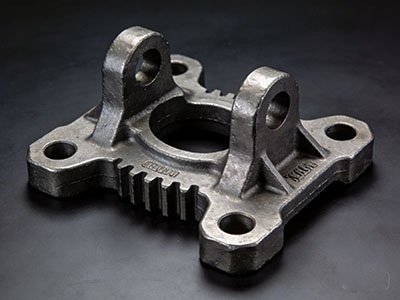
What Is ASTM A536?
ASTM A536 is the standard specification for ductile iron castings — also called nodular or spheroidal-graphite (SG) iron. Unlike gray iron's flake graphite, ductile iron's graphite forms rounded nodules that greatly reduce stress concentration, giving usable ductility and much higher strength. A536 classifies castings into five grades by minimum mechanical properties measured on cast test bars, and the grade is achieved through chemistry, nodularity control, and heat treatment rather than alloying alone.
How the Grade Numbers Work
Each ASTM A536 grade is a three-number code: tensile strength – yield strength – elongation, with strengths in ksi and elongation in percent. So 60-40-18 means 60 ksi minimum tensile, 40 ksi minimum yield, and 18% minimum elongation. As the first two numbers rise, the third (ductility) falls — strength and ductility trade off across the grade range.
ASTM A536 Ductile Iron Grades
| Grade | Tensile (min) | Yield (min) | Elong. (min) | Matrix / condition | Typical use |
|---|---|---|---|---|---|
| 60-40-18 | 414 MPa (60 ksi) | 276 MPa (40 ksi) | 18% | Ferritic (annealed) | Impact/ductility, low-temp, pressure parts |
| 65-45-12 | 448 MPa (65 ksi) | 310 MPa (45 ksi) | 12% | Ferritic-pearlitic (as-cast) | General fittings — the most common grade |
| 80-55-06 | 552 MPa (80 ksi) | 379 MPa (55 ksi) | 6% | Pearlitic (as-cast) | Gears, crankshafts, higher-strength parts |
| 100-70-03 | 689 MPa (100 ksi) | 483 MPa (70 ksi) | 3% | Quench & temper | High-strength machine components |
| 120-90-02 | 827 MPa (120 ksi) | 621 MPa (90 ksi) | 2% | Q&T / isothermal | Maximum strength, wear parts |
Per ASTM A536, 60-40-18 requires a ferritizing anneal; 65-45-12 and 80-55-06 are typically as-cast; 100-70-03 and 120-90-02 are quench-and-tempered, normalized-and-tempered, or isothermally treated.
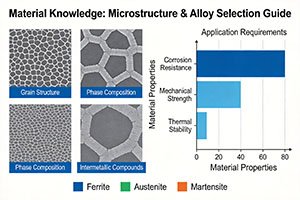
Ferritic Grades: 60-40-18 & 65-45-12
60-40-18 is the workhorse for ductility and impact toughness — its annealed, ferritic matrix delivers 18% elongation and good low-temperature performance, making it the choice for pressure-containing parts, automotive safety components, and anything subject to shock. 65-45-12 is the most widely specified grade overall: as-cast, it balances strength, ductility and machinability for general fittings, valve and pump bodies, and housings.
Higher-Strength Grades: 80-55-06 to 120-90-02
80-55-06 raises strength with a pearlitic matrix while keeping modest ductility, suiting gears, crankshafts, and higher-load components. 100-70-03 and 120-90-02 reach steel-like strengths through quench-and-temper or isothermal heat treatment, trading elongation down to 2–3% for tensile strengths of 689–827 MPa — used where strength and wear resistance dominate. These grades demand tighter process and heat-treatment control.
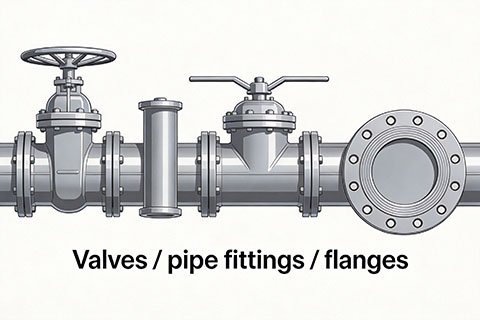
How to Select a Ductile Iron Grade
Specify the lowest grade that satisfies your strength and ductility requirements. Need impact toughness, low-temperature service, or weld/repair tolerance? Choose 60-40-18. Need a balanced general-purpose casting? 65-45-12. Need higher strength with some ductility? 80-55-06. Need maximum strength and wear resistance, and can accept low elongation plus heat treatment cost? 100-70-03 or 120-90-02. For a material-level comparison, see gray iron vs ductile iron and ductile iron vs steel.
FAQ
What do the numbers in a ductile iron grade like 65-45-12 mean?
They are minimum tensile strength, yield strength, and elongation: 65 ksi tensile, 45 ksi yield, and 12% elongation. As tensile and yield rise across ASTM A536 grades, elongation falls.
Which ASTM A536 ductile iron grade is most common?
65-45-12 is the most widely specified grade because, as-cast, it balances strength, ductility and machinability for general fittings, valve and pump bodies, and housings.
Which ductile iron grade is best for impact or low-temperature service?
Grade 60-40-18. Its ferritic, annealed matrix gives the highest elongation (18%) and the best impact toughness and low-temperature performance of the standard grades.
Do higher ductile iron grades need heat treatment?
Yes. 60-40-18 requires a ferritizing anneal, 65-45-12 and 80-55-06 are typically as-cast, and 100-70-03 and 120-90-02 are produced by quench-and-temper, normalize-and-temper, or isothermal heat treatment.
How strong can ductile iron be?
Standard ASTM A536 grades reach up to 120 ksi (827 MPa) tensile and 90 ksi (621 MPa) yield in grade 120-90-02, approaching cast steel strengths, but at low elongation (about 2%).