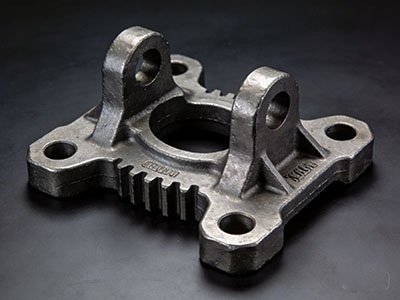
Ductile iron, also known as nodular iron or spheroidal graphite (SG) iron, is a type of cast iron invented in 1943 by Keith Millis at the International Nickel Company. What makes ductile iron unique is its microstructure: instead of the flake graphite found in gray iron, the graphite in ductile iron forms as spherical nodules. This seemingly small microstructural change produces dramatically different mechanical properties — higher strength, better ductility, and superior impact resistance — making ductile iron a versatile engineering material that competes directly with steel in many applications.
What Is Ductile Iron?
Ductile iron is cast iron that has been treated with a small amount of magnesium (typically 0.03% to 0.06%) during the melting process. This magnesium addition causes the graphite to precipitate as spheroidal nodules rather than flakes during solidification. These spherical nodules do not act as stress raisers the way flake graphite does, giving ductile iron its characteristic strength and ductility — hence the name.
The material is referred to by several names in different regions and standards:
- Ductile iron — common in North America
- Nodular iron — reflects the nodular graphite structure
- Spheroidal graphite (SG) iron — commonly used in Europe and Asia
The defining characteristic that separates ductile iron from gray iron is its ability to deform under tensile load before fracture. Gray iron has essentially zero ductility (0% elongation), while ductile iron grades offer 2% to 18% elongation depending on grade.
How Ductile Iron Is Made
The production of ductile iron involves four key steps:
1. Base iron melting. High-quality scrap steel and pig iron are melted in an electric induction or cupola furnace. The base iron chemistry is carefully controlled for carbon (3.5%–3.9%), silicon (2.0%–2.8%), manganese, sulfur, and phosphorus.
2. Magnesium treatment. The molten base iron is transferred to a treatment ladle where a magnesium-containing alloy is added. This is a critical step requiring precise control — too little magnesium leaves flake graphite (gray iron properties), while too much creates carbides and reduces ductility.
3. Inoculation. A small amount of inoculant (typically ferrosilicon) is added immediately before pouring to promote nodular graphite formation and prevent carbide formation. Inoculation also helps achieve consistent mechanical properties throughout the casting.
4. Casting. The treated and inoculated iron is poured into molds to form the desired shape. Pouring temperature, speed, and gating design all influence final quality.
The entire process from treatment to solidification must be carefully timed because the magnesium effect diminishes over time — a phenomenon called fading.
Key Properties of Ductile Iron
Ductile iron's mechanical properties make it suitable for demanding structural applications:
| Property | Ductile Iron (Grade 80-55-06) | Gray Iron (Class 30) | Cast Steel (1020) |
|---|---|---|---|
| Tensile strength | 80 ksi (550 MPa) | 30 ksi (207 MPa) | 60 ksi (414 MPa) |
| Yield strength | 55 ksi (380 MPa) | None (brittle) | 36 ksi (248 MPa) |
| Elongation | 6% | 0% | 25% |
| Density | 7.1 g/cm³ | 7.1 g/cm³ | 7.85 g/cm³ |
| Machinability | Excellent | Excellent | Good |
| Damping capacity | Moderate | Excellent | Low |
| Corrosion resistance | Good | Good | Fair |
Key advantages include high strength-to-weight ratio, excellent machinability (comparable to gray iron), good wear resistance, and the ability to be heat treated for specific property combinations. Ductile iron also exhibits excellent fatigue strength, making it ideal for rotating and cyclic loading applications like crankshafts and gears.
Interested in ductile iron castings for your project? Browse our ductile iron products.
Common Ductile Iron Grades Explained
Ductile iron grades are specified under ASTM A536 using a three-number code: tensile strength / yield strength / elongation. The table below shows the most common grades:
| Grade (ASTM A536) | Min. Tensile Strength | Min. Yield Strength | Min. Elongation | Typical Microstructure | Common Applications |
|---|---|---|---|---|---|
| 60-40-18 | 60 ksi (414 MPa) | 40 ksi (276 MPa) | 18% | Ferritic | Valve bodies, pump housings, pipe fittings |
| 65-45-12 | 65 ksi (448 MPa) | 45 ksi (310 MPa) | 12% | Ferritic/pearlitic | Brake components, compressor parts, flanges |
| 80-55-06 | 80 ksi (552 MPa) | 55 ksi (379 MPa) | 6% | Ferritic/pearlitic | Gears, wind turbine components, heavy machinery |
| 100-70-03 | 100 ksi (690 MPa) | 70 ksi (483 MPa) | 3% | Pearlitic | Transmissions, high-strength machine parts |
| 120-90-02 | 120 ksi (827 MPa) | 90 ksi (621 MPa) | 2% | Martensitic/pearlitic | Wear-resistant components, heavy equipment |
Grade 60-40-18 offers maximum ductility with 18% elongation and excellent machinability. It is typically produced with a fully ferritic microstructure through annealing and is specified for pressure-containing components and low-temperature applications.
Grade 65-45-12 is the workhorse grade — the most common choice when converting a mild steel fabrication to ductile iron casting. It balances strength, ductility, and cost.
Grade 80-55-06 provides higher strength while retaining moderate ductility. It is widely used in automotive and industrial applications where cyclic loading is present.
Grade 100-70-03 and 120-90-02 offer maximum strength at the expense of ductility. These grades are chosen for applications where wear resistance and load-bearing capacity are primary requirements.
Industrial Applications of Ductile Iron
Ductile iron is used in virtually every industrial sector:
Automotive: Crankshafts, connecting rods, gears, suspension arms, steering knuckles, and brake calipers. Ductile iron's fatigue strength makes it particularly well-suited for powertrain components that undergo cyclic loading.
Water and sewer infrastructure: Ductile iron pipe is the standard material for water distribution and wastewater systems worldwide, valued for its strength, corrosion resistance, and pressure rating.
Heavy machinery: Construction equipment components, mining machinery parts, hydraulic cylinders, and large gearboxes benefit from ductile iron's strength and wear resistance.
Wind energy: Turbine hubs, rotor components, and gearbox housings require materials with high strength, fatigue resistance, and the ability to be cast in large, complex shapes — all properties that ductile iron delivers.
Oil and gas: Valve bodies, pump casings, motor housings, and compressor components operating in demanding environments.
Ductile Iron vs Gray Iron vs Steel: Quick Comparison
| Factor | Ductile Iron | Gray Iron | Steel |
|---|---|---|---|
| Tensile strength | 60–120 ksi | 20–60 ksi | 60–200 ksi |
| Ductility | 2–18% elongation | 0% elongation | 10–40% elongation |
| Machinability | Excellent | Excellent | Good |
| Castability | Very good | Excellent | Fair |
| Cost (per part) | Moderate | Low | High |
| Vibration damping | Good | Excellent | Poor |
| Fatigue strength | Excellent | Good | Very good |
The choice between these materials depends on the specific application requirements. Where ductility and impact resistance are needed but cost is a factor, ductile iron often provides the best balance.
Not sure which material fits your design? Explore our gray iron castings or contact our engineering team.
Frequently Asked Questions
What is the difference between ductile iron and cast iron? "Cast iron" is a broad category that includes gray iron, ductile iron, white iron, and malleable iron. The key difference is graphite morphology: ductile iron has spheroidal graphite nodules, while gray iron has flake graphite. This gives ductile iron significantly higher strength and ductility.
Is ductile iron stronger than steel? Ductile iron's tensile strength (60–120 ksi) overlaps with many cast steel grades. Grade 120-90-02 has comparable strength to medium-carbon steels. However, steel generally offers higher elongation and better impact resistance. Ductile iron's advantage is lower manufacturing cost for complex shapes.
What are the standard grades of ductile iron? The most common ASTM A536 grades are 60-40-18, 65-45-12, 80-55-06, 100-70-03, and 120-90-02. Each grade specifies minimum tensile strength, yield strength, and elongation.
Can ductile iron be welded? Yes, ductile iron can be welded using nickel-based electrodes or other specialized welding procedures. Preheating and controlled cooling are typically required to prevent cracking and maintain ductility in the heat-affected zone.
What is ductile iron used for? Ductile iron is used in automotive components (crankshafts, gears), water pipe and fittings, heavy machinery parts, wind turbine components, valve bodies, and pump housings across diverse industrial sectors.
Related reading: Learn how ductile iron compares to gray iron in our detailed comparison guide.
Ready to start your ductile iron casting project? Request a quote or contact our team to discuss your requirements.