When sourcing iron castings, the first credential most buyers ask for is ISO 9001. It appears on nearly every reputable foundry's website, yet what it actually guarantees — and what it does not — is widely misunderstood. This article explains, from a buyer's point of view, what ISO 9001 certification controls inside an iron foundry, how to read a certificate, and how it fits alongside the other standards that govern cast iron quality.
What ISO 9001 Is
ISO 9001 is the international standard for quality management systems (QMS), published by the International Organization for Standardization. The current edition is ISO 9001:2015. It does not specify how good a product must be; instead it specifies how an organization must manage quality — through documented processes, defined responsibilities, measurable objectives, internal audits, and continual improvement. Certification is granted by an independent third-party registrar, typically for a three-year cycle with annual surveillance audits. A foundry holding ISO 9001 has demonstrated to an external auditor that its quality system meets the standard's requirements and is actively maintained.
What It Controls in a Foundry
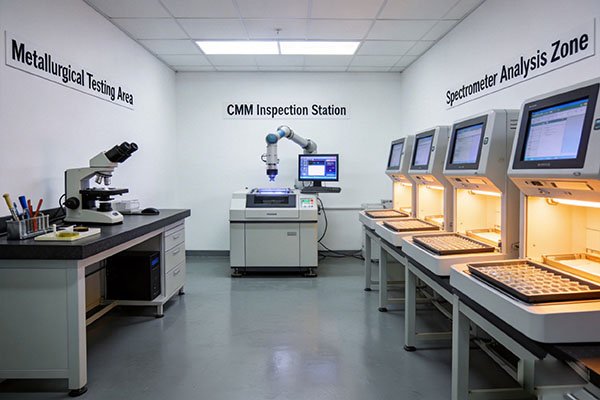
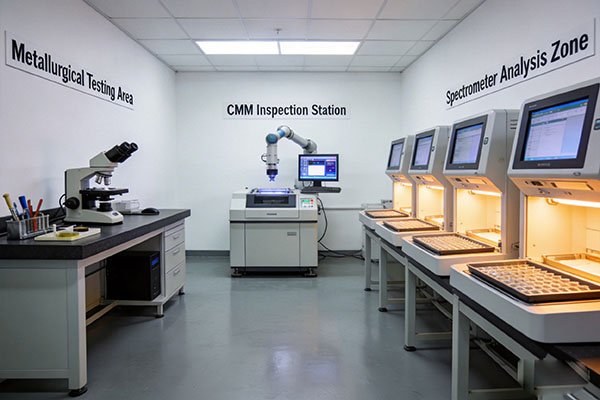
Inside an iron foundry, ISO 9001 turns abstract quality promises into traceable procedures. A certified foundry maintains documented control over incoming material inspection (pig iron, scrap, alloys, and sand), melt chemistry verified by spectrometer on each heat, molding and pouring parameters, inspection and testing at defined hold points, and nonconformance and corrective action when a casting fails. Every batch carries traceability records linking the finished casting back to its heat number and inspection results. This discipline is what allows a foundry to keep scrap rates low — well-managed iron foundries typically run scrap below 3%, versus an industry range of roughly 2% to 8% — and to repeat results across production runs rather than relying on individual operator skill.
Reading the Certificate Scope
The single most important detail on an ISO 9001 certificate is its scope statement — the activities and site the certificate actually covers. A certificate scoped to "manufacture of gray and ductile iron castings" at a named foundry address is meaningful; one scoped only to "trading" or "sales office" does not cover production. Buyers should confirm three things: the scope matches casting manufacturing, the certificate is current (check issue and expiry dates), and the registrar is accredited by a recognized accreditation body. A certificate number can usually be verified on the registrar's online database, which closes the loop on whether a document is genuine.
How ISO 9001 Relates to IATF 16949 and ASTM
ISO 9001 is the foundation, not the whole picture. For automotive castings, the relevant standard is IATF 16949, which builds on ISO 9001 and adds automotive-specific requirements such as production part approval (PPAP), advanced product quality planning (APQP), and stricter traceability. A foundry must hold ISO 9001 first; IATF 16949 then extends it for automotive supply chains. Separately, ISO 9001 says nothing about the metallurgy of a specific part — that is governed by material standards. Gray iron is certified to ASTM A48 (or EN 1561 in Europe), and ductile iron to ASTM A536 (or ISO 1083). In practice, a quality casting program combines a QMS standard (ISO 9001, plus IATF 16949 if automotive) with a material standard (ASTM/EN/ISO) for each part.
Quality Standards at a Glance
| Standard | Type | What it governs | When it applies |
|---|---|---|---|
| ISO 9001:2015 | Quality management system | Documented process control, traceability, corrective action | All reputable foundries |
| IATF 16949 | Automotive QMS (extends ISO 9001) | PPAP, APQP, automotive traceability | Automotive castings |
| ASTM A48 / EN 1561 | Material standard | Gray iron grades & tensile strength | Per gray iron part |
| ASTM A536 / ISO 1083 | Material standard | Ductile iron grades & mechanical properties | Per ductile iron part |
Use this table when reviewing a supplier: a QMS standard tells you the foundry is controlled; a material standard tells you each casting meets a defined grade. You generally want both. For a wider supplier-vetting framework, see our checklist on how to choose a reliable iron foundry.
How Buyers Verify It
To verify a foundry's ISO 9001 certification, request a copy of the current certificate and check the scope, dates, and accredited registrar; confirm the certificate number against the registrar's online register; and ask for a recent internal audit summary or customer audit report as evidence the system is lived, not just framed on a wall. Pair this with part-level evidence — material and inspection certificates per lot, and sample or first-article castings you inspect yourself. Certification establishes the system; sample inspection confirms the output. To see how defect control fits into a certified quality system, read our guide to reducing casting defects and the catalog of common iron casting defects.
FAQ
What does ISO 9001 certification mean for a foundry?
ISO 9001 certification means an independent registrar has audited the foundry's quality management system and confirmed it has documented, controlled processes for material handling, heat chemistry, inspection, traceability, and corrective action. It assures buyers the foundry runs a repeatable process, but it does not certify any individual casting's grade.
Does ISO 9001 guarantee casting quality?
Not on its own. ISO 9001 certifies the quality system, not the metallurgy of a specific part. Individual castings are certified to material standards such as ASTM A48 for gray iron or ASTM A536 for ductile iron. A strong supplier holds ISO 9001 and provides material and inspection certificates per lot.
What does a foundry need to do to get ISO 9001 certified?
The foundry must document its quality management system, define responsibilities and measurable objectives, implement process controls and records, run internal audits, then pass a certification audit by an accredited third-party registrar. Certification runs in a three-year cycle with annual surveillance audits to confirm the system is maintained.
What is the difference between ISO 9001 and IATF 16949?
ISO 9001 is the general quality management standard for any industry. IATF 16949 builds on ISO 9001 and adds automotive-specific requirements such as PPAP and APQP. A foundry needs ISO 9001 as the foundation; IATF 16949 extends it for automotive castings supplied to vehicle manufacturers.
How do I verify a foundry's ISO 9001 certificate is genuine?
Request the current certificate and check that its scope covers casting manufacturing, that issue and expiry dates are valid, and that the registrar is accredited. Confirm the certificate number on the registrar's online database, and ask for a recent audit summary as evidence the system is actively maintained.