What Is Lost Foam Casting?
Lost foam casting forms the mold cavity with a foam pattern that vaporizes when molten metal is poured, rather than being removed first. Because the pattern stays in the mold until the metal replaces it, there is no need for cores, parting lines, or draft angles. It is one of the few processes that can cast highly complex, consolidated parts in a single piece, which is why it is widely used for engine and pump components.
How Lost Foam Casting Works (Step by Step)
The process runs in five main steps:
- 1. Pattern creation — an expanded polystyrene (EPS) foam pattern is cut or molded to the exact shape of the final part.
- 2. Assembly & gating — pattern sections and the gating system are glued into one foam cluster.
- 3. Refractory coating — the cluster is dipped in a ceramic/refractory paint and dried, forming a permeable skin that controls surface finish and lets gases escape.
- 4. Molding — the coated pattern is placed in a flask and surrounded by dry, unbonded sand, which is compacted by vibration. No binder is needed.
- 5. Pouring — molten metal is poured into the pattern; the foam vaporizes and the metal takes its place, then solidifies into the casting.
Advantages of Lost Foam Casting
- Complex geometry — internal passages, holes and curves cast in one piece, with no cores or parting lines.
- Low tooling cost — foam patterns are cheaper than metal tooling, especially for complex shapes.
- Near-net shape — good dimensional accuracy and surface finish reduce downstream machining.
- Part consolidation — multi-piece assemblies can become a single casting, cutting machining and assembly.
Limitations to Consider
Lost foam is not ideal for every job. Foam pattern production adds a step and is best justified at moderate volumes; very large or very thin sections can be challenging; and pattern handling requires care because foam is fragile. Process control of the coating permeability and pouring is critical to avoid fold and gas defects. For simpler or very large parts, conventional sand casting is often more economical.
Typical Applications
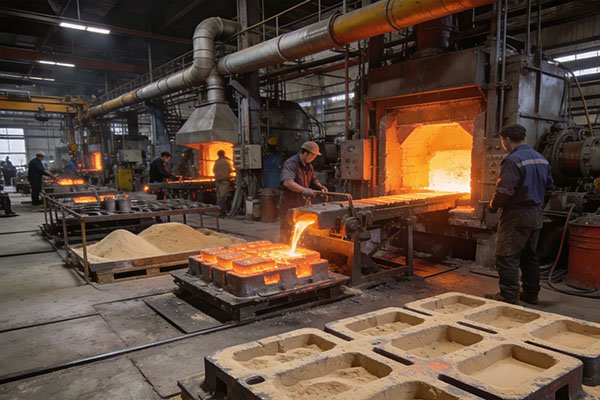
Lost foam casting suits complex, near-net-shape parts where geometry and consolidation matter. Common examples include engine blocks and cylinder heads, intake manifolds, pump and valve housings, cooling-system components, and structural brackets. It is used across automotive, marine, agricultural, and general engineering, and works well for both iron and aluminum.
FAQ
How does lost foam casting work?
An EPS foam pattern shaped like the part is coated in refractory paint, packed in dry unbonded sand, and then molten metal is poured into it. The foam vaporizes on contact and the metal fills the cavity, forming the casting with no cores or parting lines.
What are the advantages of lost foam casting?
Complex one-piece geometry with no cores or parting lines, low tooling cost, near-net shape that reduces machining, and the ability to consolidate multi-part assemblies into a single casting.
What are the limitations of lost foam casting?
It adds a foam-pattern step best justified at moderate volume, foam patterns are fragile to handle, very large or thin sections can be difficult, and it needs careful control of coating and pouring to avoid fold and gas defects.
What parts are made by lost foam casting?
Complex near-net-shape parts such as engine blocks, cylinder heads, intake manifolds, pump and valve housings, cooling-system parts, and structural brackets, in both iron and aluminum.
How is lost foam casting different from sand casting?
Both use sand molds, but lost foam uses an expendable foam pattern that vaporizes (no cores or parting lines) and dry unbonded sand, while conventional sand casting uses a removable pattern, bonded sand, and often cores. Lost foam excels at complex one-piece parts; sand casting is simpler and more economical for large or basic shapes.