What Is Investment Casting?
Investment casting, also known as lost-wax casting, is a precision process that uses a disposable wax pattern to create a high–accuracy ceramic mold. The process is well suited for complex geometries, thin walls, and applications where machining allowance and surface finish drive cost and performance.
Typical process steps:
1. Wax pattern production
- Wax is injected into a precision metal die to create individual wax patterns.
- Patterns can hold very tight dimensions, serving as a near-exact replica of the final part.
2. Pattern assembly
- Individual wax patterns are assembled onto a central wax sprue to create a –tree.–
- This allows multiple parts to be cast in one pour, improving efficiency.
3. Shell building (ceramic shell)
- The wax assembly is repeatedly dipped into a ceramic slurry and coated with refractory stucco.
- After several layers, a robust ceramic shell forms around the wax, capturing fine detail and smooth surfaces.
4. Dewax and firing
- The ceramic shell is heated to melt and drain the wax (lost-wax step).
- Firing further strengthens the ceramic mold and burns out residual wax.
5. Pouring
- Molten metal is poured into the preheated ceramic mold.
- The preheat helps avoid cold shuts and improves dimensional stability.
6. Knockout and cut-off
- After solidification, the ceramic shell is broken away.
- Individual castings are cut from the sprue and gates.
7. Finishing and inspection
- Minor grinding, blasting, or polishing is performed.
- Parts are inspected dimensionally and visually; many components go directly to assembly or light machining.
Key characteristics of investment casting
- Wax pattern / ceramic shell mold: Enables replication of complex internal and external geometries.
- No draft angle required: 0° draft is typical, which enables sharper edges, more compact designs, and reduced machining.
- Surface finish: As-cast surface finish typically in the range of Ra 1.6–6.3 µm (125–250 µin) per ISO 1302 / ASME B46.1 guidance.
- Dimensional accuracy: Commonly CT4–CT6 per ISO 8062, making it suitable for tight-tolerance parts defined under ASTM A732/A732M and similar standards.
- Minimum wall thickness: Often 0.5–1.5 mm, depending on alloy and geometry.
- Typical part size / weight: Up to about 50 kg is standard; specialized investment casters can reach ~300 kg, but cost and risk increase sharply.
- Materials: Excellent for stainless steels, tool steels, heat–resistant alloys, and many nonferrous alloys.
Applications range from aerospace and defense turbine blades and structural brackets, to industrial valve bodies and precision pump components, to ornamental hardware requiring crisp detail and high cosmetic quality.
---
What Is Sand Casting?
Sand casting is the most widely used metal casting process, leveraging packed sand molds around a reusable pattern. It is extremely flexible in part size and alloy selection and is usually the lowest-cost casting route for large or relatively simple components.
Typical process steps:
1. Pattern making
- A pattern (wood, plastic, or metal) is built to represent the geometry of the part, including draft and machining allowances.
- For cores and complex parts, core boxes are also produced.
2. Mold preparation
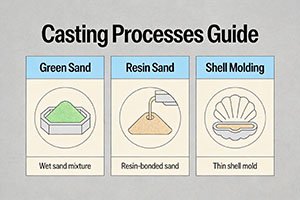
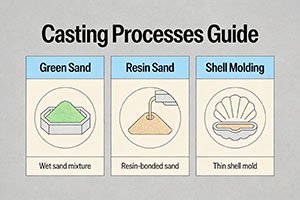
- Green sand casting: Uses moist silica sand with clay and water; ideal for high-volume production.
- Resin sand / no-bake casting: Uses chemically bonded sand; provides better dimensional stability and is suited for larger, more rigid molds.
- Sand is compacted around the pattern in cope and drag halves to form the mold cavity.
3. Core setting
- Sand cores are placed into the mold to form internal passages (e.g., water jackets in engine blocks, pump volutes).
4. Mold closing and pouring
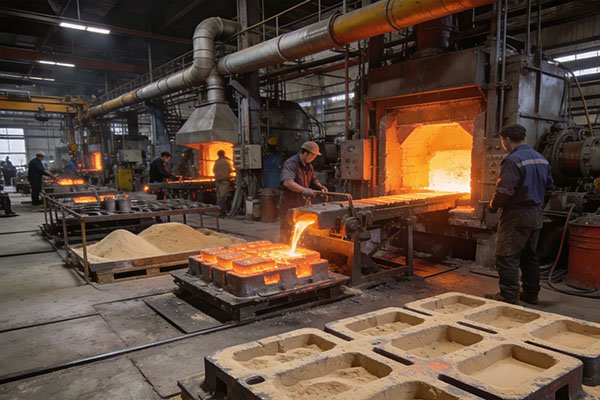
- The mold halves are closed, and molten metal is poured into the gating system.
- After solidification, the mold is shaken out to remove sand.
5. Shakeout, fettling, and finishing
- Gates, risers, and flash are removed.
- Surfaces may be shot blasted, ground, or machined depending on the specification.
Key characteristics of sand casting
- Pattern-based sand mold: Patterns are reusable; sand molds are single-use.
- Draft angle: Typically 1–3° minimum on vertical surfaces to allow pattern withdrawal and reduce mold damage.
- Surface finish: As-cast surfaces are typically Ra 6.3–25 µm (250–1000 µin) depending on sand quality and process controls.
- Dimensional accuracy: Usually CT7–CT12 per ISO 8062; tolerances are looser than investment casting and more sensitive to process variables.
- Minimum wall thickness: About 3–5 mm in green sand; 4–6 mm for large no-bake molds. Thin sections pose higher risk of misrun or porosity.
- Maximum part weight: Practically unlimited in no-bake sand; very large castings over 50 tons are routine in heavy industry.
- Materials: Broadest range, including ASTM A48 gray iron, ASTM A536 ductile iron, carbon and low alloy steels, aluminum, bronze, and other nonferrous alloys.
Sand casting is the default choice for engine blocks (automotive), large pump housings and frames, valve bodies where surface finish is noncritical, heavy machinery bases, and utilitarian products such as manhole covers.
---
Investment Casting vs Sand Casting: Head-to-Head Comparison
For procurement engineers and designers, the decision is rarely about which process is –better,– but which delivers the required performance at the lowest total cost and risk. The table below summarizes how investment casting vs sand casting compare across key engineering and commercial criteria.
Comparative Overview
| Dimension | Investment Casting (Lost-Wax) | Sand Casting (Green / No-Bake) |
|---|---|---|
| Dimensional accuracy (CT grade) | Typically CT4–CT6 | Typically CT7–CT12 |
| Surface finish (Ra) | 1.6–6.3 µm (125–250 µin) | 6.3–25 µm (250–1000 µin) |
| Minimum wall thickness | 0.5–1.5 mm, depending on alloy | 3–5 mm (green sand); 4–6 mm (no-bake) |
| Maximum part weight | Typically up to 50 kg; specialized up to ~300 kg | From grams to 50+ tons (no-bake) |
| Draft angle | 0° (no draft required) | 1–3° minimum typical |
| Design complexity | Very high: undercuts, fine detail, intricate internal geometry | Moderate: cores required for internal passages; undercuts limited |
| Undercuts | Readily achievable using soluble wax or ceramic cores | Limited; often avoided or require complex core packages |
| Tooling cost | Wax injection die: ~$3K–$30K+ | Pattern: ~$500–$5K (higher for very large / complex) |
| Per-part cost – low volume | Relatively high; tooling amortization is expensive at small volumes | Usually lower; ideal for prototypes and small batches |
| Per-part cost – high volume | Decreases significantly with volume; attractive for 500–10,000+ parts/year | Remains competitive, especially for simple geometries and large parts |
| Lead time – first article | Typically 6–12 weeks for first article | Typically 2–6 weeks for first article |
| Material options | Wide range, especially stainless, tool steels, high–temp alloys; often per ASTM A732/A732M | Broadest overall: ASTM A48 gray iron, ASTM A536 ductile iron, steels, aluminum, bronzes |
| Minimum order quantity (economic) | Best economics in medium volumes (hundreds to thousands) | Fits both prototypes and very high volume green sand production |
How to Interpret These Trade-offs
- If you need tight dimensional accuracy (CT5 or better) and fine surface finish, investment casting commonly reduces or eliminates machining. This can offset higher tooling cost, especially when parts are difficult to machine (e.g., hardened steels, complex valve internals).
- If your priority is low cost per kilogram and the design is fairly simple with generous tolerances, sand casting almost always wins, particularly for larger parts.
- When weight reduction and packaging constraints drive thin walls and complex geometry, investment casting allows you to design closer to the functional shape, instead of adding stock for draft and machining.
- For very large components or products where a textured, –as-cast– surface is acceptable, sand casting is effectively the only viable option.
The optimal choice is often determined during early design. Engaging a foundry that offers both processes allows you to model cost, risk, and performance without redesigning around a single process bias.
---
Cost Comparison: Investment Casting vs Sand Casting
Cost is usually the decisive factor after performance requirements are understood. Both tooling cost and per-part cost need to be considered over the planned program volume.
Tooling Cost
- Investment casting tooling
- Wax injection dies typically run $3,000–$30,000+, depending on part size, cavity count, and complexity (slides, inserts, surface detail).
- This investment is justified when you have stable long-term demand or when machining savings are significant.
- Sand casting tooling
- Patterns for green sand or no-bake molds usually cost $500–$5,000 for small to medium parts, with large patterns costing more.
- For short runs, patterns can be built from wood or printed tooling to minimize up-front cost.
Per-Part Cost and Break-even Volume
Investment casting tends to have:
- Higher melting and shell costs per kg than sand molds.
- Lower machining and finishing costs because of better CT grade and surface finish.
Sand casting tends to have:
- Lower molding cost per kg but
- Higher machining and fettling costs, especially when tighter tolerances or smoother surfaces are required.
A practical way to view it:
- For a complex steel component that would need substantial machining when sand cast, the break-even volume where investment casting becomes more economical often lies around 500–2,000 parts per year.
- For simple geometries (e.g., flanges, simple brackets), sand casting usually remains cheaper regardless of volume because machining and finishing effort remain modest.
- At very low volumes (tens of parts), sand casting nearly always wins due to low tooling and faster lead time.
Actual pricing depends on alloy, size, tolerance, and yield, but early cost modeling with your foundry can reveal whether investment casting–s higher tooling is offset by downstream savings in machining, scrap, and assembly.
---
When to Choose Investment Casting
Investment casting is the better fit when the part design and performance requirements demand precision and complexity.
Typical decision criteria:
- Complex geometry with undercuts and internal passages
- Parts that would require multiple cores and complex core assembly in sand casting, or that cannot be cored at all.
- Examples: turbine blades, turbocharger wheels, intricate valve internals.
- Thin walls and weight reduction
- Walls under 3 mm, down to 0.5–1.5 mm, are achievable depending on alloy and geometry.
- Enables lighter, more compact designs and improved dynamic performance for rotating components.
- Superior surface finish and tight tolerances
- Surface finish Ra 1.6–6.3 µm reduces grinding, polishing, and mating surface machining.
- Dimensional accuracy CT5 or better reduces or eliminates many machining operations.
- High-value materials and high-spec applications
- Stainless steels, tool steels, and heat-resistant alloys where machining is slow and tool wear is high.
- Appropriate for parts aligning with ASTM A732/A732M steel and alloy investment casting requirements.
- Moderate production volumes
- Typically 500–10,000 parts per year where tooling amortization is reasonable and machining savings accumulate.
If the part would be extremely difficult or expensive to machine after sand casting, investment casting often yields a lower total cost of ownership.
---
When to Choose Sand Casting
Sand casting delivers the best value where flexibility in size and low tooling cost are more important than tight tolerances and surface finish.
Typical decision criteria:
- Large parts over 50 kg
- Pump and compressor housings, gear cases, machine bases, structural frames, and large valve bodies.
- No-bake molds in particular can handle castings in the multi-ton range.
- Simple to moderate geometry
- Components with straightforward cores and generous radii.
- Examples: ASTM A48 gray iron housings, covers, and brackets.
- Lower surface finish and wider tolerances acceptable
- When a Ra 6.3–25 µm surface is acceptable or when machining will clean up functional surfaces regardless.
- CT7–CT12 accuracy is adequate for many industrial components.
- Very high volume production
- Green sand lines can produce high volumes with low cost per part once tooling is amortized, making them ideal for automotive engine blocks and other repeat parts.
- Very low volume or prototype runs
- For dozens or a few hundred parts, low-cost patterns and quick mold changes make sand casting the faster and cheaper route.
- Ferrous materials emphasis
- Particularly ASTM A536 ductile iron and other irons where sand casting is the established, cost-effective standard.
If your main requirement is to move metal into a general shape economically and machining is already planned, sand casting typically offers the best cost position.
---
Real-World Examples: Which Process Was Best?
1. Complex Valve Body – Investment Casting
Challenge A fluid handling OEM needed a corrosion-resistant valve body with multiple intersecting internal passages and tight envelope constraints. A sand cast design required several complex cores and 4–5 mm of machining stock on key surfaces.
Process selected Investment casting in stainless steel to CT5 accuracy, with no draft and thin-walled passages.
Why it worked
- Allowed 0° draft and near-net internal geometry, eliminating several complex cores.
- As-cast surface finish around Ra 3–4 µm reduced internal port machining.
Result / ROI
- Machining time per part dropped by approximately 40%, with fewer setups.
- Overall unit cost decreased once volume exceeded about 1,000 parts/year, despite higher tooling cost.
---
2. Large Pump Housing – Sand Casting
Challenge An industrial pump housing weighing roughly 200 kg required robust wall sections, moderate tolerances, and standard paint finish. The component needed to withstand severe service but did not require cosmetic surfaces.
Process selected No-bake sand casting in ductile iron (ASTM A536).
Why it worked
- Investment casting was not practical due to size and mass.
- No-bake sand molds allowed robust cores for internal passages with manageable tooling cost.
Result / ROI
- Tooling costs remained within a reasonable budget and were recovered quickly.
- The foundry delivered consistent quality with CT8–CT9 dimensional control, and machining allowed final tolerances where required.
---
3. Low-Volume Automotive Bracket – Sand Casting
Challenge A specialty automotive bracket for an off-road application required 200 pieces in the first year, with uncertain long-term volume. Geometry was modest, and machining was acceptable on mating surfaces.
Process selected Green sand casting in ASTM A48 gray iron, followed by machining of critical holes and faces.
Why it worked
- Investment casting tooling would have been costly relative to uncertain volume.
- Sand casting offered a short lead time (–4 weeks to first article) and low pattern cost.
Result / ROI
- Total project cost (tooling + piece part + machining) was significantly lower with sand casting at the specified volume.
- Design changes were easily incorporated by modifying the pattern, without reworking expensive investment tooling.
---
Matson's Capability: Both Processes Under One Roof
Many foundries promote either investment casting or sand casting–but not both–forcing you to commit to a process before you have comparative data. Matson takes a different approach.
- Full-spectrum casting services
- Investment casting and lost-wax capabilities for precision components.
- Sand casting process options including green sand, resin sand, and no-bake molds for small to very large parts.
- Engineering-driven process selection
- Our engineers evaluate your model, tolerance stack-up, and functional requirements against CT grades, Ra targets, and cost drivers.
- We can present side-by-side scenarios–investment casting vs sand casting–before you lock in design features like draft angle, wall thickness, or core design.
- Integrated quality and machining
- Quality systems and inspection aligned with relevant standards (ASTM A48, A536, A732/A732M and ISO dimensional/surface standards).
- Access to machined castings capability, delivering parts closer to ready-for-assembly condition.
By offering both processes
FAQ
What is the main difference between investment casting and sand casting?
Investment casting uses a disposable wax pattern and ceramic shell for high precision and a fine surface finish, while sand casting uses a sand mold for lower cost and much larger part sizes. Investment casting holds tighter tolerances (about CT4-CT6) and smoother surfaces; sand casting is more economical and has virtually unlimited part size.
Which is cheaper, investment casting or sand casting?
Sand casting has lower tooling cost (roughly $500-$5,000 vs $3,000-$30,000 for investment) and lower per-part cost, so it is cheaper for most parts. Investment casting wins on total cost only when its tighter tolerance and finish remove enough machining to offset the higher tooling, typically on complex parts at higher volumes.
When should I choose investment casting over sand casting?
Choose investment casting for complex geometries, thin walls (down to about 0.5 mm), tight tolerances, and fine surface finish where reduced machining justifies the higher tooling cost. Choose sand casting for large, simpler, or cost-sensitive parts.
How large a part can each process make?
Sand casting has virtually no upper size limit and can produce parts up to 50+ tons. Investment casting is limited to small and medium parts by the ceramic shell process.
Does Matson offer both investment and sand casting?
Yes. Matson provides both investment casting and sand casting under one roof, so we can recommend and produce the process that best fits your part's geometry, tolerance, volume, and budget.