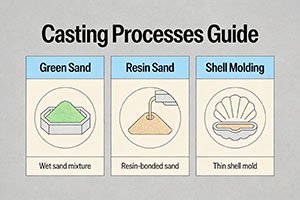
The three main sand casting processes—green sand, resin sand, and no-bake—differ primarily in mold material, dimensional accuracy, surface finish, and production-volume suitability. Green sand (clay-bonded) is typically the most economical for high-volume production. Resin sand (shell mold / resin-coated sand) delivers better finish and accuracy for small to medium parts. No-bake (chemically bonded, air-set) offers the best dimensional control and design freedom for large, complex, low-volume castings. For material context on alloys poured in these processes, see our guide to ductile iron properties and the full sand casting process guide.
What Is Green Sand Casting?
Green sand casting is the most widely used and lowest-cost sand casting process in iron foundries worldwide. "Green" refers to the fact that the sand mold is used in a damp, uncured state. The green sand casting process uses a mixture of silica sand, bentonite clay, water, and small additives compacted around a pattern to create the mold.
How the green sand casting process works
In a typical green sand casting process:
- Sand preparation – Silica sand is blended with bentonite clay (as the binder), water, and other additives. The bentonite clay swells in the presence of water and provides cohesion.
- Mold making – The green sand is compacted around a pattern using jolting, squeezing, or high-pressure molding. This forms the cope and drag halves of the mold.
- Core setting (if needed) – Separate cores, often also made from sand but with different binders, are placed to form internal passages.
- Pouring and solidification – Molten iron (e.g., ASTM A48 gray iron or ASTM A536 ductile iron) is poured into the mold cavity.
- Shakeout and reclamation – Once solidified, the casting is removed and the sand is broken down and reclaimed. Green sand systems routinely achieve 95 percent plus sand reclamation, making them highly recyclable.
Key characteristics and performance
Green sand is the most common and lowest-cost sand molding method. Automated molding lines can achieve 200–400 molds per hour, making it ideal for high-volume production. The process is compatible with a broad range of ferrous materials, including common grades of gray and ductile iron.
Typical performance benchmarks:
- Surface finish: RMS 250–500
- Dimensional accuracy: CT7–CT9 (depending on size and geometry)
- Wall thickness: Down to about 2.5 mm (0.1 in) in optimized systems
- Sand reclamation rate: 95%+
Because molds are compacted around the pattern, pattern wear can become a factor over long production runs, especially with high-pressure molding. Moisture and venting must be controlled to avoid common iron casting defects such as gas porosity and scabbing.
Typical green sand casting applications
Green sand casting is well suited to high-volume, repeatable parts where ultra-fine surface finish and tight tolerances are not the primary drivers:
- High volume engine block production using green sand
- Automotive brake components using green sand
- Pipe fittings and flanges
- Agricultural components (housings, brackets)
- Pump housings and general industrial components with moderate complexity
For simple iron castings at scale, the green sand cost per part can be under USD 1 per kg, making it extremely competitive compared with other metal forming processes.
Pros and cons of green sand casting
Pros
- Lowest cost per part at high volumes
- Very high productivity (200–400 molds/hour)
- High sand recyclability (95%+)
- Flexible for a wide range of sizes and alloys
- Well-established process control and tooling availability
Cons
- Rougher surface finish (RMS 250–500) vs resin and no-bake
- Lower dimensional accuracy (CT7–CT9)
- More machining allowance typically required
- Pattern wear due to high compaction forces
- Moisture-related defects (gas, scabbing) if not well controlled
What Is Resin Sand Casting? (Shell Mold / Resin-Coated Sand)
Resin sand casting, commonly associated with the shell mold process, uses sand that is pre-coated with a thermosetting resin. The resin-coated sand is heated against a metal pattern at around 200–300°C, causing the resin to cure and form a thin, rigid shell mold. This method bridges the gap between traditional green sand and fully chemically bonded no-bake molds.
How the shell mold / resin sand casting process works
- Resin-coated sand preparation – Silica sand is coated with a thermosetting resin and sometimes a lubricant. This is supplied as ready-to-use shell sand.
- Pattern heating – The metal pattern is preheated to the target temperature, typically 200–300°C.
- Shell formation – The resin-coated sand is dumped over or blown against the hot pattern. A thin shell (often 5–15 mm thick) cures and adheres to the pattern.
- Backing and assembly – The shell halves are stripped, assembled, and backed with bulk sand or shot to support the mold.
- Pouring – Molten metal is poured into the shell mold, producing a casting with a smoother surface and better consistency than green sand.
Performance characteristics
Resin sand casting offers a significant upgrade in both surface finish and dimensional accuracy over green sand:
- Surface finish: RMS 125–250
- Dimensional accuracy: CT6–CT8
- Thin-wall capability: Generally better than green sand due to rigid shell walls
- Cleaning and fettling: Reduced, thanks to cleaner mold-metal interface
Because shell molds are thinner and more precise, less riser and gating metal may be required, and final machining stock can be reduced versus green sand.
Typical resin sand casting applications
Resin sand casting is common for medium-volume, higher-value components where surface quality and dimensional repeatability are important:
- Medium volume valve body production using resin sand
- Pump impellers and casings requiring good hydraulic surface finish
- Automotive components needing good finish and dimensional repeatability
- Smaller and medium-sized iron castings under ASTM A48 and ASTM A536 with tighter tolerance requirements
Pros and cons of resin sand casting
Pros
- Improved surface finish: RMS 125–250
- Better dimensional accuracy: CT6–CT8
- Good thin-wall capability
- Reduced cleaning, grinding, and machining stock
- Good process repeatability for medium-volume runs
Cons
- Higher sand cost than green sand
- Limited sand reclamation compared with green sand systems
- Slower production rate vs high-speed green sand lines
- Pattern tooling must withstand repeated heating cycles
- Typically best suited to small and medium-sized parts
What Is No-Bake Sand Casting? (Air-Set / Self-Setting Sand)
No-bake sand casting, also called air-set or self-setting sand, uses chemically bonded sand that cures at room temperature. Instead of moisture and clay, this process relies on a resin binder—commonly furan or phenolic—mixed with a liquid catalyst to harden the sand into a rigid mold.
How the no-bake sand casting process works
- Binder system – Silica sand is mixed with a small percentage of furan resin or phenolic resin and a hardener (acid catalyst).
- Mold and core making – The mixed sand is packed into flasks or core boxes around the pattern. Within minutes, the chemical reaction hardens the sand at room temperature.
- Strip and assemble – Once cured, the mold halves and cores are stripped, assembled, and prepared for pouring.
- Pouring and cooling – Molten iron is poured into the rigid mold, which maintains excellent dimensional stability during solidification.
- Shakeout and reclamation – After solidification, the mold is broken down. No-bake sand reclamation rates are commonly 60–80 percent, lower than green sand due to binder burn-on and mechanical degradation.
Because the mold walls are rigid and not moisture-dependent, no-bake delivers the best dimensional control and is particularly suited to very large and complex castings.
Performance characteristics
No-bake is often the process of choice for mission-critical, large iron castings:
- Surface finish: RMS 90–200 (finest of the three, in well-controlled systems)
- Dimensional accuracy: CT5–CT7
- Max casting weight: 50+ tons is achievable in large flasks
- Design flexibility: Handles large cores, complex internal geometries, and heavy section changes
No pattern heating is required, and tooling is generally less stressed because sand is hand- or mechanically-packed without the high clamp pressures of green sand molding.
Typical no-bake sand casting applications
- Large custom pump housing using no-bake
- Heavy equipment castings using no-bake
- Large valve bodies and manifolds with complex internal passageways
- Machine tool beds, press frames, and structural castings
- Low-volume dies, molds, and specialty industrial castings
These castings are typically produced in ASTM A48 gray iron or ASTM A536 ductile iron grades where dimensional integrity, structural soundness, and traceability are critical.
Pros and cons of no-bake sand casting
Pros
- Best dimensional accuracy: CT5–CT7
- Finest surface finish: RMS 90–200
- Ideal for very large castings (50+ tons possible)
- Excellent design freedom for complex cores and internal passages
- No pattern heating, lower pattern stress vs high-pressure green sand
Cons
- Slower production rate; cure time and handling limit throughput
- Higher sand and binder cost
- Sand reclamation lower: typically 60–80%
- Requires more floor space and handling equipment
- Best suited to low- to medium-volume projects
Green Sand vs Resin Sand vs No-Bake: Side-by-Side Comparison
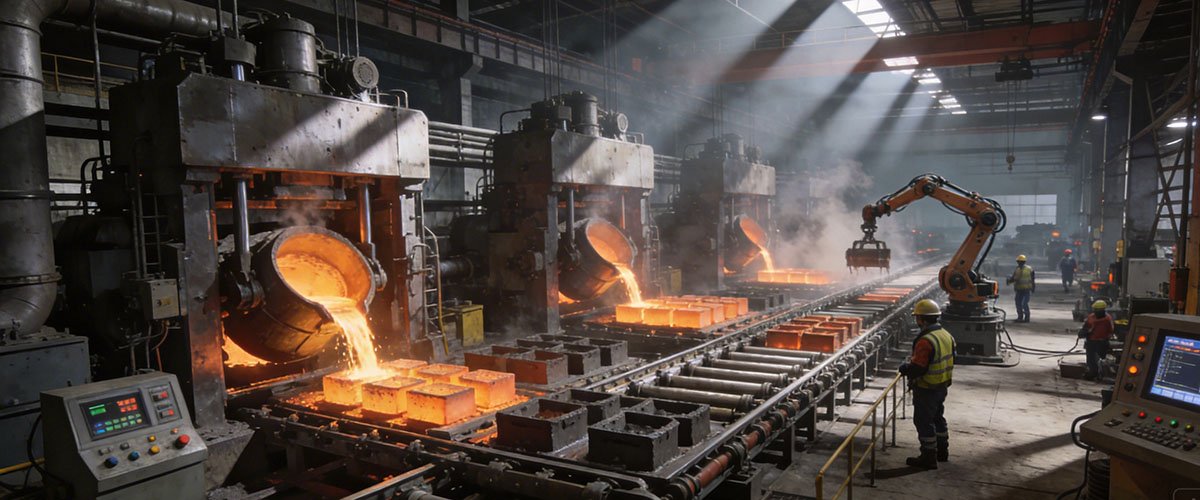
Below is a data-driven sand casting methods comparison to support procurement and engineering decisions when evaluating green sand vs resin sand vs no-bake casting.
| Parameter | Green Sand Casting | Resin Sand Casting (Shell Mold) | No-Bake Sand Casting (Air-Set) |
|---|---|---|---|
| Process principle | Clay-bonded damp sand compacted around pattern | Resin-coated sand cured on hot pattern | Chemically bonded sand cured at room temperature |
| Binder system | Bentonite clay + water | Thermosetting resin on sand (shell sand) | Furan or phenolic resin + acid catalyst |
| Cure method | Mechanical compaction (no thermal cure) | Thermal cure at 200–300°C | Chemical reaction (air-set) |
| Dimensional accuracy (CT grade) | CT7–CT9 | CT6–CT8 | CT5–CT7 |
| Surface finish (RMS) | 250–500 | 125–250 | 90–200 |
| Typical wall thickness (min) | ~2.5–4 mm | ~2–3 mm | ~3–5 mm (depends on part size and alloy) |
| Max part weight | From ounces to several tons | Typically small to medium; usually < 500–800 kg | 50+ tons achievable |
| Mold production rate | 200–400 molds/hour (automated lines) | Lower; suited to medium volume | Lowest; manual or semi-automatic molding |
| Pattern/tooling cost | Moderate; robust patterns needed for compaction | Higher; precision metal patterns, heated | Moderate; patterns not heated, lower squeeze load |
| Cost per part (low volume) | Less economical | Moderate to high | Most economical for large/complex parts |
| Cost per part (medium volume) | Competitive, may be overkill for oversized parts | Very competitive | Competitive for larger, complex castings |
| Cost per part (high volume) | Under USD 1/kg for simple parts | Typically higher than green sand | Generally highest per piece |
| Sand reclamation rate | 95%+ | Moderate, lower than green sand | 60–80% |
| Lead time to first parts | Short for simple tooling | Moderate (pattern + heating setup) | Moderate to long, especially for large molds |
| Design complexity capability | Simple to moderately complex | Complex thin-wall parts; limited size | Highest: large, complex cores and sections |
How to Choose the Right Sand Casting Process
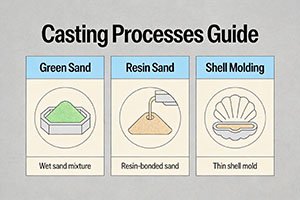
When deciding which casting process to choose, procurement and engineering teams should start with a few core parameters: annual volume, part size, geometry complexity, surface finish, tolerances, and budget.
1. Annual volume and production strategy
- High volume (>10,000 pcs/year): Green sand casting is usually the best choice. With mold rates of 200–400 per hour and highly automated lines, it minimizes cost per part. This is why high volume engine blocks and automotive brake components are typically produced with green sand.
- Medium volume (1,000–10,000 pcs/year): Resin sand casting is often ideal. It offers better surface finish and more accurate, repeatable geometry than green sand, with tooling and operating costs that are justifiable at these volumes. Valve body production and pump components fall in this range.
- Low volume (<1,000 pcs/year): No-bake sand casting becomes cost-effective, especially for large, complex parts. Tooling is simpler, and the process is flexible enough to handle engineering changes and one-offs.
2. Part size and mass
- Small to medium parts: Green sand or resin sand both work; choose based on finish/tolerance requirements and cost targets.
- Large parts (hundreds of kg to 50+ tons): No-bake is the preferred method. Rigid molds, long solidification times, and heavy sections are best handled in an air-set system.
3. Geometry, tolerances, and surface finish
- Standard tolerances, moderate geometry, standard Ra/RMS: Green sand (CT7–CT9, RMS 250–500) is adequate and most economical.
- Improved finish and tighter fit: Resin sand (CT6–CT8, RMS 125–250) is better for sealing surfaces, precision machined interfaces, and hydraulic components.
- Tight tolerances and high complexity: No-bake (CT5–CT7, RMS 90–200) is the best choice, particularly for multi-core assemblies, large valve bodies, and heavy equipment frames.
4. Budget and machining strategy
If machining capacity is limited or machining costs are high, investing in resin sand or no-bake to reduce allowances can be justified. If lowest casting cost per kilogram is the primary driver and machining is inexpensive or already available, green sand remains highly competitive. Many structural components are supplied as gray iron castings from green sand lines with post-cast machining.
How Matson Iron Casting Supports All Three Processes
Matson Iron Casting is structured to give procurement and engineering teams a single source for all three foundry sand casting types—green sand, resin sand, and no-bake. That means you can match each component to the most cost-effective process without managing multiple foundries.
In one facility, we produce high-volume green sand castings (engine, brake, and agricultural components), precision resin sand castings (valve bodies, pump impellers), and large no-bake castings (pump housings, machine tool beds, heavy equipment structures). Our metallurgical lab supports full chemical analysis for ASTM A48 gray iron and ASTM A536 ductile iron grades, as well as mechanical testing and non-destructive testing (NDT) including magnetic particle and ultrasonic inspection. Review our integrated casting services or contact our engineering team to align process selection with your drawings and volume plan.
Frequently Asked Questions
Which sand casting process is most cost-effective for low-volume production?
For low-volume production, particularly of large or complex iron parts, no-bake sand casting is typically the most cost-effective overall. While the per-mold cost is higher than green sand, tooling is simpler, setup is more flexible, and the process avoids the overhead required to justify a high-speed green sand line. For small low-volume parts, resin sand can also be competitive, especially when machining cost reduction is important.
What surface finish can I expect from green sand vs resin sand vs no-bake?
Green sand surface finish: typically RMS 250–500, suitable for many structural and general industrial components.
Resin sand surface finish: typically RMS 125–250, good for valve bodies, pump components, and parts where sealing surfaces and aesthetics matter.
No-bake surface finish: typically RMS 90–200, providing the cleanest as-cast surfaces among the three, especially on large, high-integrity castings.
Can the same foundry handle all three sand casting processes?
Yes, some foundries—like Matson Iron Casting—are specifically equipped to manage green sand casting, resin sand casting, and no-bake sand casting under one roof. This allows you to source different components from the same supplier while optimizing each part for cost, performance, and risk. When evaluating a supplier, confirm that they have dedicated sand systems, reclamation, and quality controls for each process.
What is the typical lead time for green sand compared to no-bake casting?
Green sand casting typically offers shorter lead times for standard-sized parts once tooling is in place, thanks to high mold production rates (200–400 molds per hour) and automated handling. No-bake casting, especially for large or complex molds, generally involves longer mold preparation and handling times, leading to longer lead times, but with higher flexibility for engineering changes and low-volume scheduling.
Is resin sand casting better than green sand for complex geometries?
For small to medium-sized parts with complex geometries, resin sand casting (shell mold process) often performs better than green sand. The rigid shell molds handle thin sections and intricate details more reliably and yield better dimensional accuracy (CT6–CT8 vs CT7–CT9) and surface finish. However, for very large complex parts, no-bake is usually the superior choice.
How does no-bake casting compare in dimensional accuracy?
No-bake casting generally provides the best dimensional accuracy among the three, typically in the CT5–CT7 range. The chemically bonded, rigid molds exhibit minimal deformation under thermal and metallostatic loads, which is especially important for large, heavy iron castings where even small dimensional changes translate into significant absolute deviations.
Need help choosing the right sand casting process? Get a Quote or Contact Engineering Team — our engineers will recommend green sand, resin sand, or no-bake based on your volume, tolerances, and budget.