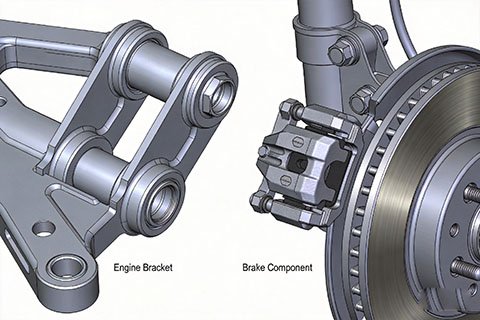
Iron castings remain essential in modern automotive manufacturing for engine blocks, brake calipers, suspension arms, differential housings, and exhaust manifolds. Gray iron, commonly specified under ASTM A48 and SAE J431 for automotive use, delivers excellent thermal conductivity and damping for powertrain components. Ductile iron, typically supplied to ASTM A536 grades such as 65-45-12 and 80-55-06, provides the strength and fatigue resistance needed for safety-critical chassis and suspension parts. Compared with steel fabrications, iron castings can deliver 15–25 percent weight savings, 30–50 percent less machining, and 10–20× better vibration damping. Most automotive iron castings are produced through the sand casting process, which supports the complex geometries and production volumes typical of OEM programs.
Why Iron Castings Remain Essential in Modern Automotive Manufacturing
Despite the growth of aluminum and composite materials, iron castings automotive industry applications still account for a major share of drivetrain, brake, and chassis hardware. In global automotive casting output, iron remains a dominant material by tonnage, with roughly 40 percent of casting volume still linked to iron-based parts. That position is not accidental: iron combines cost efficiency, castability, dimensional stability, and high-temperature performance in a way that remains hard to replace at scale.
For OEM engineers, the key advantage is not simply material availability. It is the ability to cast complex geometry close to final shape, reduce weld count, and engineer properties directly into the microstructure. Gray iron offers excellent damping capacity, typically absorbing 10–20 times more vibration energy than steel, which helps reduce NVH in engines, brakes, and housings. Ductile iron adds strength and fatigue resistance for parts exposed to impact loading, cyclic stress, and road shocks.
Iron also continues to win on economics. In many automotive programs, cast iron material cost lands around USD 0.30–0.60 per lb, while steel plate is often USD 0.50–0.80 per lb before fabrication. When machining, joining, and scrap rates are included, iron castings can be significantly more competitive than steel weldments, especially in medium-volume production. That is why automotive casting foundry sourcing remains central for platforms that need durability, repeatability, and cost control.
Key Automotive Components Made from Iron Castings
Automotive cast iron components span the powertrain, brake, chassis, and exhaust systems. Material selection depends on load case, thermal exposure, and manufacturing route. For detailed product capabilities, see our gray iron castings and ductile iron castings pages, or explore our full range of automotive applications.
Engine Blocks and Cylinder Heads (Gray Iron / Compacted Graphite Iron)
Engine block production is still one of the most important automotive engine block production using gray iron or CGI applications. A typical inline 4 engine block weighs roughly 30–80 kg, while a large V8 diesel block can approach 200 kg depending on design and duty cycle. Gray iron remains attractive because of its thermal conductivity, usually around 40–50 W/mK, along with machinability and vibration damping.
For higher-output or heavier-duty engines, compacted graphite iron (CGI) is increasingly used. CGI offers roughly 75 percent higher tensile strength than gray iron while preserving better thermal fatigue behavior than many lightweight alternatives. That makes it well suited for high-pressure diesel blocks, cylinder heads, and other components where combustion loading has intensified over the last decade.
Brake Calipers and Rotors (Gray Iron — G3000 / G3500)
Brake system castings for passenger vehicles and heavy trucks rely on iron because of thermal stability, wear resistance, and friction behavior. Brake calipers, brackets, and rotor-adjacent structures must survive repeated heating and cooling without distortion. A gray iron brake caliper or rotor carrier can withstand severe thermal cycling while supporting consistent pedal feel and predictable service life.
Brake caliper weight often ranges from 3–8 kg, depending on axle position, vehicle class, and whether the caliper is integral or bracket-based. Gray iron grades G3000 and G3500 are commonly specified for brake rotors and caliper bodies where damping, stiffness, and cost matter more than absolute weight reduction. In heavy vehicles, iron castings remain especially important because braking loads, heat rejection, and long-life durability are more demanding than in many passenger-car programs.
Suspension Arms and Steering Knuckles (Ductile Iron — 65-45-12 / 80-55-06)
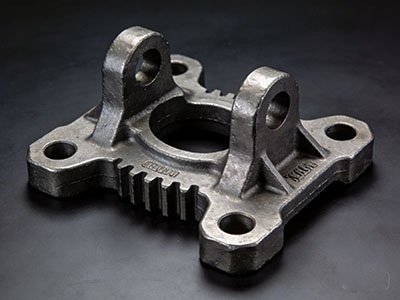
Suspension and steering components for light-duty and commercial vehicles frequently use ductile iron because it offers the toughness needed for impact and fatigue resistance. Typical applications include control arms, steering knuckles, subframes, and certain knuckle-adjacent supports. A ductile iron suspension arm is especially attractive when the design must absorb road shock while maintaining dimensional stability under load.
Ductile iron tensile strength commonly falls in the 450–550 MPa range for automotive grades 65-45-12 and 80-55-06, with elongation around 6–12 percent depending on section size and specification. That combination makes it much tougher than gray iron, which is why it is used for parts that see alternating loads, pothole strikes, curb impacts, and steering duty. For OEMs and suppliers, the material supports robust performance without the cost and joining complexity of fabricated assemblies.
Automotive applications often require machined castings with precise tolerances and consistent quality.
Differential Housings and Gearbox Casings (Ductile Iron)
Differential and transmission housings are another strong fit for iron castings in the automotive industry. These parts benefit from stiffness, dimensional stability, and the ability to isolate vibration from gear mesh and drivetrain harmonics. Gray iron is often used for economy and damping, while ductile iron is selected when higher structural margins are needed.
Housing design has a major influence on noise and long-term durability. Iron helps absorb vibration from internal gears and rotating assemblies, lowering the transmission of harshness into the cabin and reducing stress at mounting points. For light trucks, commercial vehicles, and off-road platforms, this balance of stiffness and damping is especially valuable.
Exhaust Manifolds and Turbocharger Housings (Alloy Cast Iron / SiMo)
Exhaust manifold operating temp can reach 800–900 °C, which places severe demands on thermal fatigue resistance and oxidation behavior. Gray iron has long been used for exhaust manifolds because it tolerates heat cycling well and resists distortion. In some high-performance applications, ductile iron or alloyed grades are selected when additional strength is needed.
SiMo alloy cast iron is often considered when thermal shock resistance and high-temperature stability are priorities. It is useful in exhaust manifolds, turbocharger housings, and related components exposed to repeated spikes in temperature. For OEMs, these alloys are a practical middle ground between standard gray iron and more exotic heat-resistant metals, especially where cost and castability must be preserved.
Gray Iron vs Ductile Iron for Automotive Applications
Gray iron and ductile iron are both essential automotive cast iron components materials, but they solve different engineering problems. Gray iron is stronger in compression, offers superior damping, and machines very well. Ductile iron provides far better tensile performance, elongation, and impact resistance, making it better suited for safety-critical and load-bearing parts. For deeper material context, see our ductile iron guide and the full gray iron vs ductile iron comparison.
| Property | Gray Iron | Ductile Iron |
|---|---|---|
| Microstructure | Graphite flakes | Spheroidal graphite nodules |
| Typical tensile strength | Lower than ductile iron | 450–550 MPa common automotive range |
| Yield strength | Moderate | Higher than gray iron |
| Elongation | Very low | 6–12 percent typical |
| Fatigue resistance | Good in compression, limited in tension | Strong for cyclic loading |
| Damping capacity | Excellent | Good, but lower than gray iron |
| Thermal conductivity | About 40–50 W/mK | Good, generally below gray iron |
| Machinability | Excellent | Good, though typically more demanding than gray iron |
| Wear resistance | Excellent | Good to very good |
| Typical automotive use | Engine block, brake caliper, manifolds, housings | Suspension arm, steering knuckle, housings, heavy-duty brackets |
The selection question is usually not which iron is "better" overall. It is which iron better matches the load case, manufacturing route, and cost target. If the part needs damping, thermal conductivity, and machinability, gray iron often wins. If it must carry tensile loads, survive shock, and support long fatigue life, ductile iron is usually the better answer.
Cost and Performance Advantages of Iron Castings vs Steel Fabrications
Against steel fabrications, iron castings offer a compelling manufacturing advantage. Near-net-shape casting reduces secondary machining and eliminates many weldments, brackets, and assembly steps. In many programs, machining reduction vs steel weldments is 30–50 percent, which can materially lower total part cost and simplify production planning. Finished components often benefit from machined castings services that reduce downstream assembly time.
There is also a direct weight and packaging benefit. Weight savings vs steel commonly reaches 15–25 percent when a casting is optimized for geometry rather than designed as a welded assembly. Cast iron's ability to consolidate multiple features into a single piece reduces fasteners, join lines, distortion risk, and quality escape points.
| Metric | Iron Castings | Steel Fabrications |
|---|---|---|
| Material cost | USD 0.30–0.60 per lb | USD 0.50–0.80 per lb |
| Machining requirement | Lower | Higher |
| Weld content | Low to none | Often significant |
| Damping capacity | 10–20× more vibration energy absorption than steel | Lower |
| Geometry complexity | High, in a single casting | Limited by welding and forming |
| Lead-time sensitivity | Moderate, tooling dependent | Moderate to high, fabrication dependent |
For procurement teams, the most important metric is total cost of ownership, not only piece price. Iron castings often reduce downstream cost through simpler assembly, fewer purchased components, and less machining time. That becomes especially important on high-volume platforms where a few dollars per component can scale to significant annual savings.
Quality Standards for Automotive Iron Castings
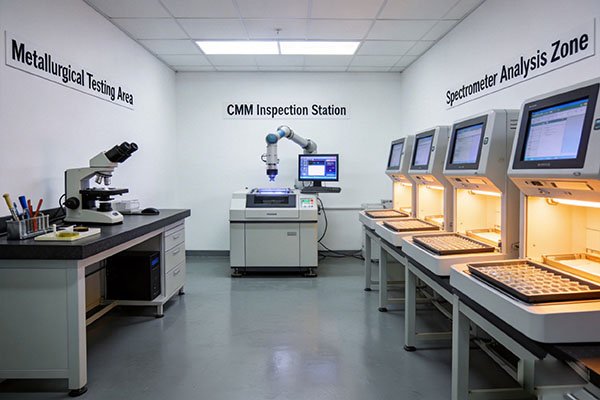
Automotive buyers typically require supplier systems built around IATF 16949. This certification signals that the foundry understands automotive-specific process control, traceability, risk management, corrective action, and continuous improvement requirements. For launch programs, OEMs and Tier 1s often also expect APQP discipline, PPAP readiness, and process capability evidence on critical dimensions.
Material conformance is usually specified against ASTM A48 for gray iron castings and ASTM A536 for ductile iron castings. SAE J431 is also relevant for automotive gray iron applications because it aligns foundry chemistry and performance expectations with vehicle-duty requirements. In practice, the buyer should verify both chemistry and mechanical properties, especially across varying section thicknesses.
Inspection is equally important. NDT requirements often include magnetic particle inspection, ultrasonic testing, and radiographic inspection for critical castings. Dimensional verification using CMM and 3D scanning is common for complex geometries such as engine blocks, steering knuckles, and housings with multiple machined datums. A mature automotive casting supplier should document capability, traceability, and control plans from melt to final inspection through comprehensive quality control services.
How Matson Iron Casting Serves the Automotive Industry
Matson Iron Casting supports automotive customers with gray iron, ductile iron, and alloy castings for demanding production environments. Its capabilities are aligned with short- to medium-run production flexibility, which is valuable for OEMs and Tier suppliers managing platform changes, service parts, and niche vehicle programs. That flexibility helps bridge prototype, validation, and production phases without forcing a complete supplier change.
For purchasing teams, the core value is a foundry partner that understands both performance and manufacturability. Automotive programs need consistent metallurgy, stable dimensions, and responsive scheduling. A supplier that can offer multiple iron families, engineering input, and automotive quality discipline is better positioned to support launch risk reduction and long-term supply continuity.
Frequently Asked Questions
What types of iron are used in automotive castings?
Gray iron (classes G2500–G4000) is used for engine blocks, brake calipers, and exhaust manifolds. Ductile iron (grades 65-45-12, 80-55-06, 100-70-03) is used for suspension arms, steering knuckles, and differential housings. Compacted Graphite Iron (CGI) is increasingly used for high-performance diesel engine blocks.
Are iron castings being replaced by aluminum in modern vehicles?
Aluminum has replaced iron in some engine and body applications, particularly where weight reduction is the primary driver. However, iron castings remain widely used for brake components, many engine blocks, suspension parts, and housings where damping, thermal stability, wear resistance, and cost efficiency are critical. Iron and aluminum often coexist on the same vehicle platform, each selected for its engineering strengths.
What are the typical tensile strength requirements for automotive gray iron castings?
Automotive gray iron castings are typically specified to ASTM A48 Class 30–40 or SAE J431 grades G2500–G3500, with minimum tensile strengths in the 207–276 MPa (30–40 ksi) range. Brake rotors and caliper bodies often use G3000 or G3500 grades. Higher-duty applications such as diesel engine blocks may use compacted graphite iron with tensile strengths exceeding 400 MPa.
How does ductile iron compare to cast steel for suspension components?
Ductile iron grades such as 65-45-12 and 80-55-06 offer tensile strengths of 450–550 MPa with 6–12 percent elongation, comparable to many cast steel grades. Ductile iron provides better damping, lower material cost, and superior castability for complex geometries. Cast steel may offer higher elongation in some grades, but ductile iron typically wins on total cost of ownership for near-net-shape suspension and steering components.
What quality certifications should an automotive casting foundry have?
Automotive casting foundries should hold IATF 16949 certification, which demonstrates compliance with automotive quality management system requirements. Buyers should also expect APQP/PPAP readiness, material conformance to ASTM A48 (gray iron) or ASTM A536 (ductile iron), documented NDT capability (MPI, UT, radiography), and dimensional verification using CMM or 3D scanning for critical features.
Can iron castings reduce vehicle weight compared to steel fabrications?
Yes. When a component is redesigned from a steel weldment to an optimized iron casting, weight savings of 15–25 percent are commonly achievable. Cast iron's near-net-shape capability consolidates multiple features into a single part, eliminating weldments, brackets, and excess material. Combined with 30–50 percent less machining and significantly better vibration damping, iron castings often deliver lower total cost alongside meaningful weight reduction.
Ready to discuss your automotive casting requirements? Get a Quote or contact our engineering team to review material selection, tooling, and production planning for your program.