Design Guides
Engineering best practices for defect-free, cost-effective cast iron components.
Get Design Support →Key Design Principles for Castings
1. Uniform Wall Thickness
Avoid abrupt thickness changes to prevent shrinkage porosity and warpage. Recommended range for iron castings: 6–12 mm. Gradual transitions only where necessary.
2. Draft Angle
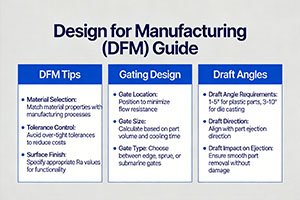
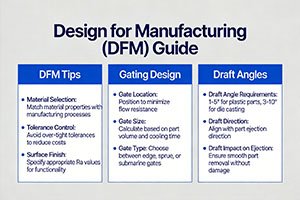
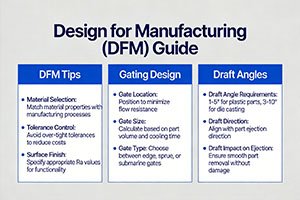
Required to remove the casting from the mold without damage. Recommended: 1°–2° per side (larger for deeper cavities). Increases tool life and surface quality.
3. Fillets & Radii
Eliminate sharp internal corners to reduce stress concentration and crack risk. Rule of thumb: fillet radius ≈ nominal wall thickness. External radii also improve flow.
4. Avoid Sharp Corners
Sharp corners cause hot spots, shrinkage defects, and premature mold erosion. Always use radii or chamfers.
Bad vs. Good Design
Small changes in geometry dramatically affect castability and final quality.
❌ Poor Design
- Abrupt wall thickness change → shrinkage cavity
- Sharp internal corner → crack initiation
- No draft angle → sticking, surface tear
✅ Optimized Design
- Gradual thickness transition → sound structure
- Generous fillet radius → stress distribution
- Proper draft → smooth ejection
Design Considerations
Parting Line
Position to minimize core complexity and flash. Avoid critical functional surfaces.
Shrinkage Allowance
Pattern must be oversized (approx. 1-2% for gray iron, 0.8-1.5% for ductile iron).
Ribs & Bosses
Add stiffness without increasing wall thickness. Keep rib thickness ≤ 0.8 x main wall.
Holes & Cavities
Cored holes reduce weight and machining. Minimum hole diameter: 12 mm for green sand.

Why Work With Us?
- 30+ years of casting design experience
- Free DFM (Design for Manufacturability) analysis
- Pattern design, gating & riser optimization
- Simulation software (solidification & flow analysis)
Our engineers collaborate with you from concept to production, ensuring your design is castable, cost-effective, and defect-free.
Request Design Review →Optimize Your Casting Design Today
Upload your drawing or 3D model and receive professional DFM feedback within 24 hours.